Tuesday, 31 August 2021

2021 Light-Up Mid-Autumn Festival SYS's Lawn

Note: "Those Moonlit Moments..." installed on 30th August 2021

Coming on the 15th day of the eighth lunar month this year, the Mid-Autumn Festival, also known as Mooncake Festival, is one of the most important festivals for Chinese communities around the world including Singapore.
Many locals celebrate mid-autumn festival every year.

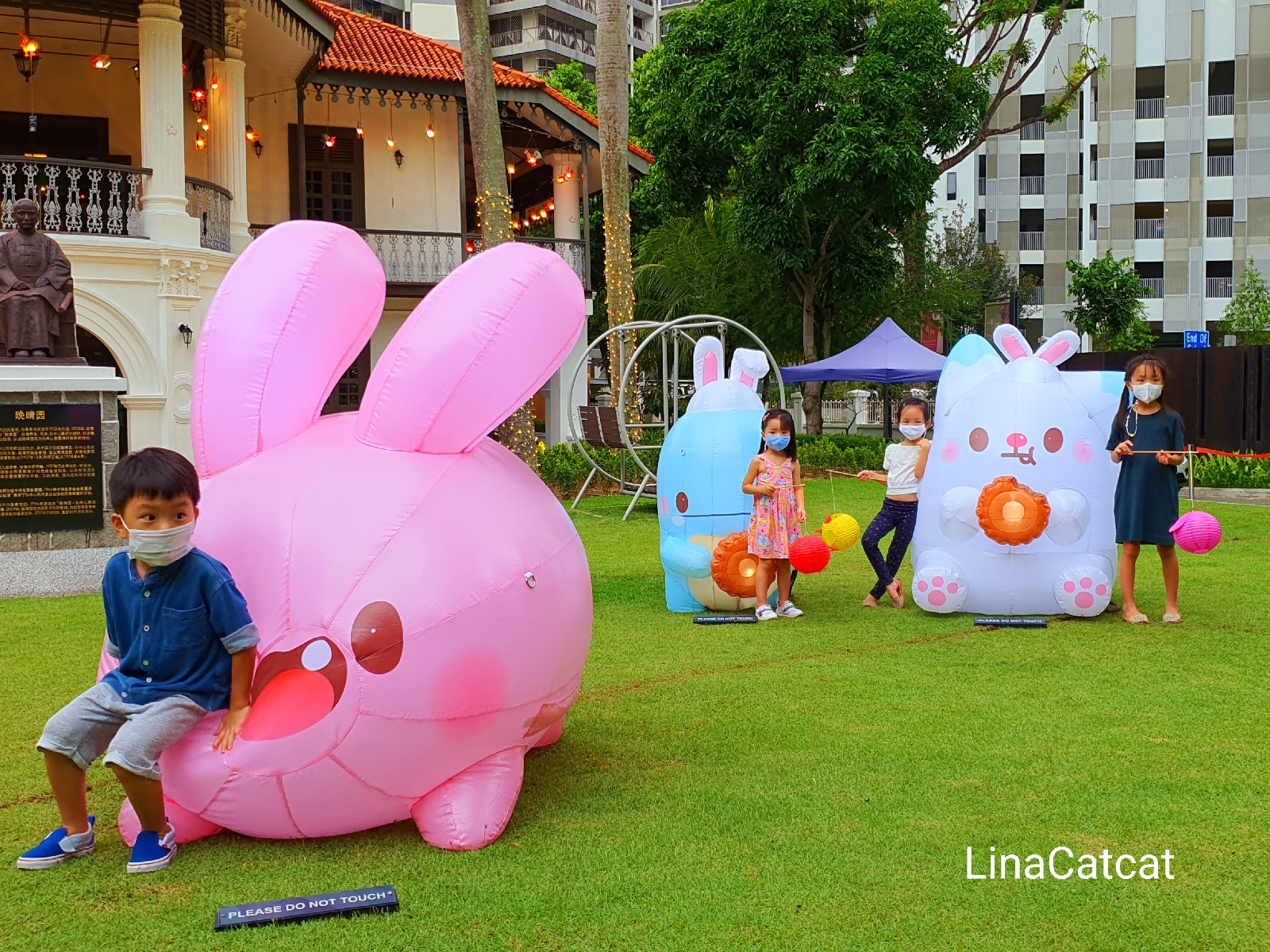
Lantern Installation: “Those Moonlit Moments..”

Those Moonlit Moments … is an outdoor installation comprising four large lanterns featuring the artist’s characters who are enjoying mooncakes and each other’s company under the gentle and watchful eye of Ngaew’s Moon Rabbit. The Moon Rabbit character was created specially for the Mid-Autumn Festival and is inspired by the Jade Rabbit from Chinese folklore which keeps the goddess Chang’e company on the moon.
The lantern (above pic) produced by Thailand artist Boonyavee Boonsakda (Ngaew Ngaew) in collaboration with the Sun Yat Sen Nanyang Memorial Hall.
The installation represents our collective wish to be able to get together and reunite with our loved ones, both locally and overseas, during these difficult times. It will be on display on the lawn of the Memorial Hall from 31 August to 26 September 2021, 10am to 9pm daily.
Date: 31 Aug – 26 Sept 2021
Time: 10.00am – 9.00pm (daily)
                   Lantern "Lion"
Digital Programmes
There is a digital programmes online via the memorial hall’s Facebook page (@sysnmh), this year’s Wan Qing Mid-Autumn Festival aims to bring heritage closer to home, through an exciting line-up of family-friendly digital initiatives such as learning how to guess lantern riddles, craft demonstrations and gamified content on the stories of Chang’e, Houyi and many more. 
                  Lantern Riddle
Deciphering Lantern Riddles! (for Children and Adult)
Date: 22nd Sept 2021 (for children)

Lantern Riddles often contain messages of wisdom and good fortune, and they are a fun way to practise language and problem-solving skills. Hints are provided to indictate whether the answer is a person, place, item or an idiom. Introduce your children to lantern riddles, and join them in the first episode with Riddle
 Association (Singapore) and Bong Qiu Qiu to find out the strategies and the thought process behind guessing lantern riddles.

There will be second episode for Adults with Riddle Association (Singapore) and Bong Qiu Qiu to find out the strategies and tips to guess the lantern riddles.
Date: 23rd Sept 2021 (for Adult)

What does Your Lantern Say About You?
Date: 14th Sept 2021
Lighting lanterns is a popular traditional activity associated with the Mid-Autumn Festival - they chase away the darkness, light the way home at night, and represent a desire for union and the aspiration for a better life. Most importantly, lighting add a touch of festivity and are a great fun for all ages. Find out the five types of lanterns most frequently found in Singapore, and which type of lantern may be more suitable with which type of personality! 
Could be your personality tells yo
u to pick one lantern of your choice? 😁

Help Hou Yi Shoot the Suns
Date: 17th Sept 2021
Did you know? Legend has it that there used to be tens scorching suns and it caused famines and sufferings to the people. An expert archer, Hou Yi shoot down nine of them and was rewarded with an immortal elixir. Help Hou Yi shoots the suns and learn more about the stories of Chang'e and Hou Yi!

Mid-Autumn Craft Tutorial: Create Your Own Unique Lantern
Date: 21st Sept 2021
Get your creative juices flowing and try your hand at making your own unique lantern! With the help of their DIY Mid-Autumn craft tutorial. Yoy could be able to explore using upcycled materials for a unique Mid-Autumn experience.

Learn More About Jade Rabbit
Date: 24th Sept 2021
Have yoy ever wondered why the rabbit is often featured in designs and decorations for the Mid-Autumn festival? Fibd out more from the video to learn the story of Jade Rabbit, its selflessness and its kindness!

Let's Celebrate Mid-Autumn Festival with Uncle Ting!
Date: 6th Sept 2021
Looking for activities to engage
 your child at home? Download our children's activity kit - Let's Celebrate with Uncle Ting: Mid-Autumn Festival to learn about the origins and traditions of this festival, the different types of mooncakes perferred by different dialect groups, and many more!

For more information and programmes click here 

Photos taken within Sun Yat Sen Memorial Hall during installation on 30th August 2021.
Thanks to Alvin Tan and his teams organising the media preview for installation of "Those Moonlit Moments..." We had an enjoyable time.
        Alvin Tan and his teams

Saturday, 13 July 2019

Kreta Ayer - New Heritage Gallery

Kreta Ayer Community Club
Along Kreta Ayer road was once a settlement area for early Chinese immigrants to Singapore thus became famous for cultural arts scene including Chinese Opera troupes and music scene that took place here. I have been watched Chinese Opera and puppet shows in my area since 1970s till 2000s and my mum was once an artist opera/performer (Sin Sai Hong troupe) in her younger days and she still love to watch it on TV when there is one. Those were the good old days.
The community where it stands along the Kreta Ayer road - Kreta Ayer Community Club is holding a official ceremony on the 14th July 2019, featuring a new Kreta Ayer Heritage Gallery in its premise to focus its rich cultural history. 
Kreta Ayer Heritage Gallery
The Kreta Ayer Heritage Gallery showcase which is slated to open to public on Sunday 14th July and will feature its five intangible cultural heritage elements: Chinese Opera, Nanyin instruments, Chinese puppetry, Chinese painting & calligraphy and Chinese tea ceremony.
A Cantonese Opera Male Kao (armor) costume
A Cantonese Opera Female Kao (armor) costume
This is a typical costume worn by an actor/actress playing a male/female general during battle scenes in a Chinese opera performance. The body of the costume is usually covered in scale-like motifs, which are modelled after ancient Chinese armor. Compared to the male general's costume, female kao costumes tend to incorporate a shoulder cape and more feminine touches such tassels. The Four-triangular flags attached to the back of the costume are a reference to pennants of command awarded to generals in the past. They also symbolise preparedness for war, and heightens the costume's dramatic effect. The flags can be removed after the battle scene is completed.
Chinese Opera Shoe (female)
Embroidered motifs worn by a "wu sheng" in a Chinese opera
Many of the cultural arts and traditional instruments were brought here by migrants from southern China which is linked to Kreta Ayer's rich culture history. There will be performing shows including puppet shows and lots of programmes.
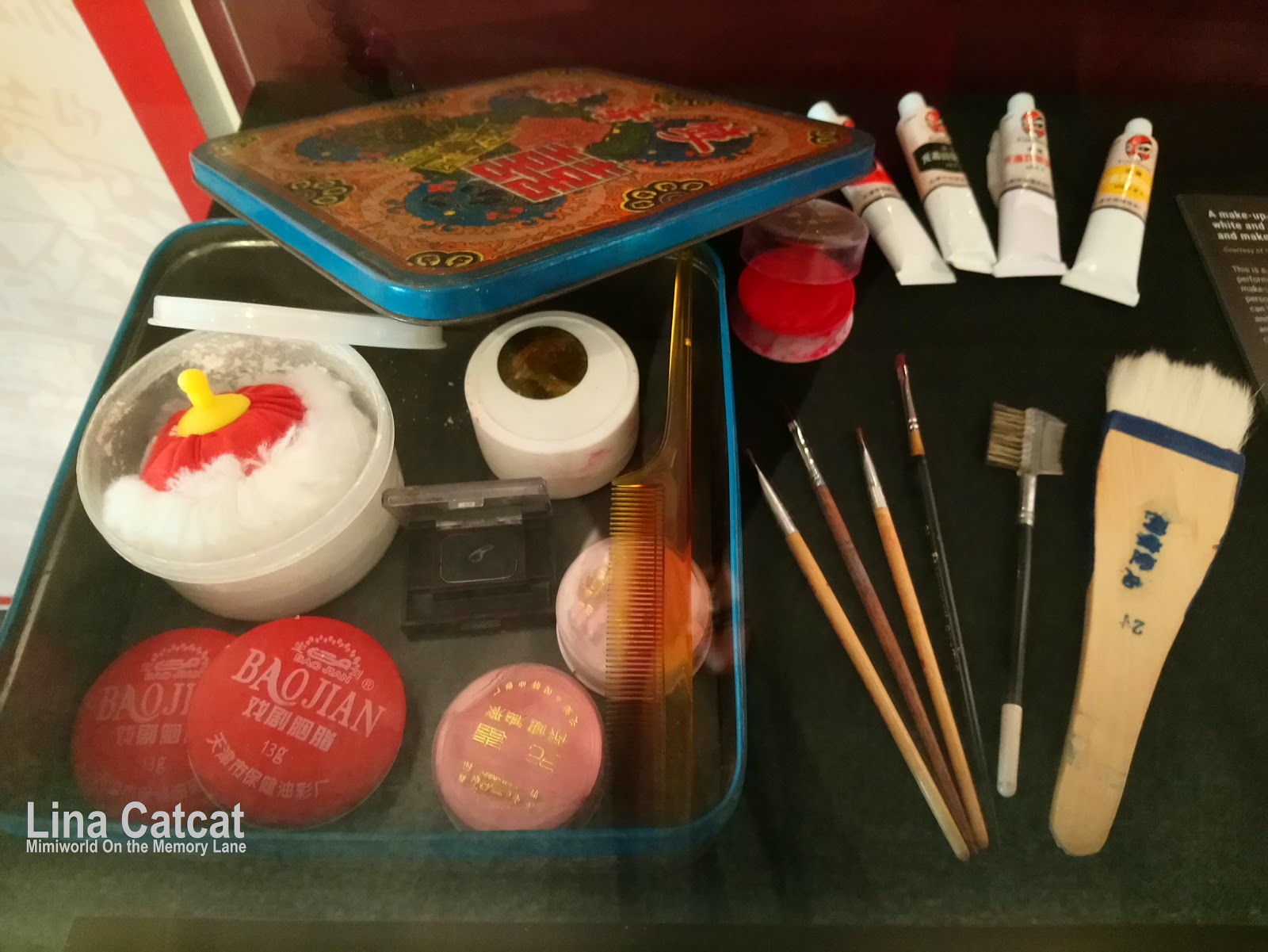
Typical make-up set
A make-up set containing black, white and rouge colours, a powder puff and a make-up brushes were used by opera performers. The colours and style in Chinese opera make-up are used to enhance the facial characteristics personality of a character. Different colours of make-up connote different meanings.
A wooden make-up box (loan by Part Woh Wui Koon)
This e-up box was typically used by the performers playing hua dan (young female) characters before WWII.
Puppet Theater
Puppet Doll
 Puppet accessories
Puppetry is an ancient form of artistic expression that is a variation on storytelling or human theatrical production. In puppetry, a drama unfolds that is entrirly or primarily acted out by specialized representational objects, which are manipulated by a puppeteer. The human animator may or may not be visible to the audience. Cultural variations of puppetry developed independently in many parts of the world, with distinctive types still carried on today.
Marionettes on strings or wire
A marionette is a puppet controlled from above using wires or strings depending on regional variations. A marionette's puppeteer is called a marionettist.


Marionette on strings

Marionettes were usually carved from pieces of wood and the assembled parts are hung on strings. Chinese marionette plays are mostly performed in the open air without a curtain to conceal the puppeteers.
Visitors may try their hand at the calligraphy, puppet shows, tea refreshment ceremony and more programmes that will held inside the gallery.
Nanyin music Instruments
Bamboo Flute (Dong Xiao) 
Some of the traditional instruments were donated by Siong Leng Musical Association for public viewing and education. These cultural practices still exists to this day. The gallery features showcase more than 170 photographs and artefacts contributions from cultural practitioners and former residents.
Chat Thye Poh's notebook
courtesy of Cindy Chat
This notebook used by Chat Thye Poh to record Cantonese opera lyrics. It was written on the first page are the actor's lines from a scene in a Cantonese opera entitled Li Qi Ran Jian ("Li Qi's cries from the Prison Cell" in Mandarin).
Membership Pass for Part Woh Wui Koon
(Cantonese Opera Artistes Guild)
courtesy of Cindy Chat
This Membership Pass was issed in 1956, belongs to Chat Thye Poh who joined Part Woh Wui Koon in 1934. The Guild that establilished for member of the Cantonese opera, was founded in 1857 and still operated in Keong Saik Road.
Vinyl records of Cantonese opera
Other contributors include: Ms Joanna Wong, a Cultural medallion winner and veteran Cantonese opera artist; Mr Yong Cheong Thye, an award-winning calligraphy artist; and Nanyin Musical group Siong Leng Musical Association.
Old Photographs of yesteryears
Notable items on display such as old photographs dating back to the 1970s that set the scene of the popularity and dynamism of Chinese Opera. In the late 1960s, Kreta Ayer's People Theatre used to host performances by international opera troupes in 1970s.
Gong Che Pu score book
There is one of a set of 3 Gong Che Pu score books containing around 300 original compositions, the music notes are created by the late Teng Mah Seng.
This is the first such gallery co-curated by National Heritage Board (NHB), community centre and key stakeholders to focus on intangible cultural heritage.
Admission to the Heritage Gallery is FREE. Operating hours from 12pm-8pm daily. It is located at the newly upgraded Kreta Ayer Community Club along Kreta Ayer road in Chinatown.
NHB Alvin Tan and friends(by invitation) at Kreta Ayer CC
Note: National Heritage Board (NHB) organises a special preview of the new Kreta Ayer Heritage Gallery on the 13th July and its official opening on Sunday (14th July) with tea ceremony and other programmes.
Exhibition wall panel
In addition, there is an exhibition wall panel just outside the Kreta Ayer People's Theatre. It was officially reopened in July 14th 2019 by Mr Chan Chun Sing, Minister for Trade and Industry, and Deputy Chairman of People's Assocication.
Below is a short video taken inside the Heritage Gallery. 

Saturday, 4 November 2017

Luxury Black and White Bungalows at Adam Park

Road to Adam Park Estate
Adam Park is one site where a series of war events unfolded. If you have a nice house that can't save everything then you've to think how to protect these structures and its heritage.
In the morning on 04th Nov, we took a cab instead of bus or station as it's just a short distance from my place about 10 mins. We arrived at 7 Adam Park before 9.45am and it's still early. As it could be the last series of 8th tours which was started on July 2017 conducted by Jerome Lim, supported by SLA.
View of 7 Adam Park
We roamed around the house and took some shots of the building and some quickie selfie shots with them.
7 Adam Park Bungalow
Upon reaching at 7 Adam Park Colonial house (NUSS Guild House), does it look familiar I recall that the house was once occupied by 7Adam - a chic and stylish restaurant-gallery in 2012. 
Selfie Before the Tour
The Adam Park Estate was an exclusive expat residential area with 19 huge colonial black-and-white houses, tucked away in the jungle and plantations of Singapore. Cocktails were sipped and long hours were whiled away at the country club playing golf in the years before the WWII. The estate was the site of an intense three days of fighting in the battle for Singapore. The men of the 1st Battalion Cambridgeshire Regiment held off a series of attacks by the troops of the Japanese 41st (Fukuyama) Regiment but the island collapsed to the Japanese.
The Allied soldiers were sent to Changi Prison and the estate was turned into a prisoner of war (POW) camp, with Japanese soldiers using the homes as a base.
The Colonial bungalow at 7 Adam Park that was used to house with Art Gallery, restaurant and workshops (for family and kids) in 2012 till early 2014. I remember that my friends once told me about Art Gallery and restaurant at Adam Park years ago. I did visited once in 2013 with two of my old friends for a meal at the park. 

No 13 Adam Park (2014)
In Jun 2014, I looked up 'The Adam Park Project (TAPP2)', is a ground breaking battlefield archaeology project managed by Jon Cooper, looking into the wartime heritage of the Adam Park housing estate in Singapore and joined them as volunteer digger to dig up the soil looking for relic items at No. 13 Adam Park. My interest is to look in its heritage of the building and its rich history of the battlefield as well as wars relic objects. 
Me Holding A Cap Badge@13 AdamPark
At the last moment, I unearthed a cap badge from Royal Corps of Signals at No 13 Adam Park in Jun 2014 as if God sent me down to look for it. That was 3 years ago!


Sunday, 22 October 2017

Former NPF and View Rd "Mental' Hospital

View of former NB Police Qrts/View Rd Hospital
Most everybody knows about Woodbridge Hospital, but little is known about View Road Hospital which I used to call it - 'Mental Hospital', situated at the end of View Road, off Admiralty Road West. It's the kind of isolated place that you would easily miss. Yes, I had been there, visited one of my relatives who had mental illness and my dad's brother since 1980s - early 1990s. The most closest patient of mine is my dad's brother who was a patient almost 2 decades till his mother (paternal grandma) brought him home and stayed with her who lived at Ghim Moh estate (demolished) before it closed in 2001. I remember I visited him once every month due to my hectic work, only my paternal grandma often visited him. At one time, she told me that her son almost jumped down from the building. I do not want to talk about it as it saddened me to think of how sick he is and he is very quiet, stared at the wall.
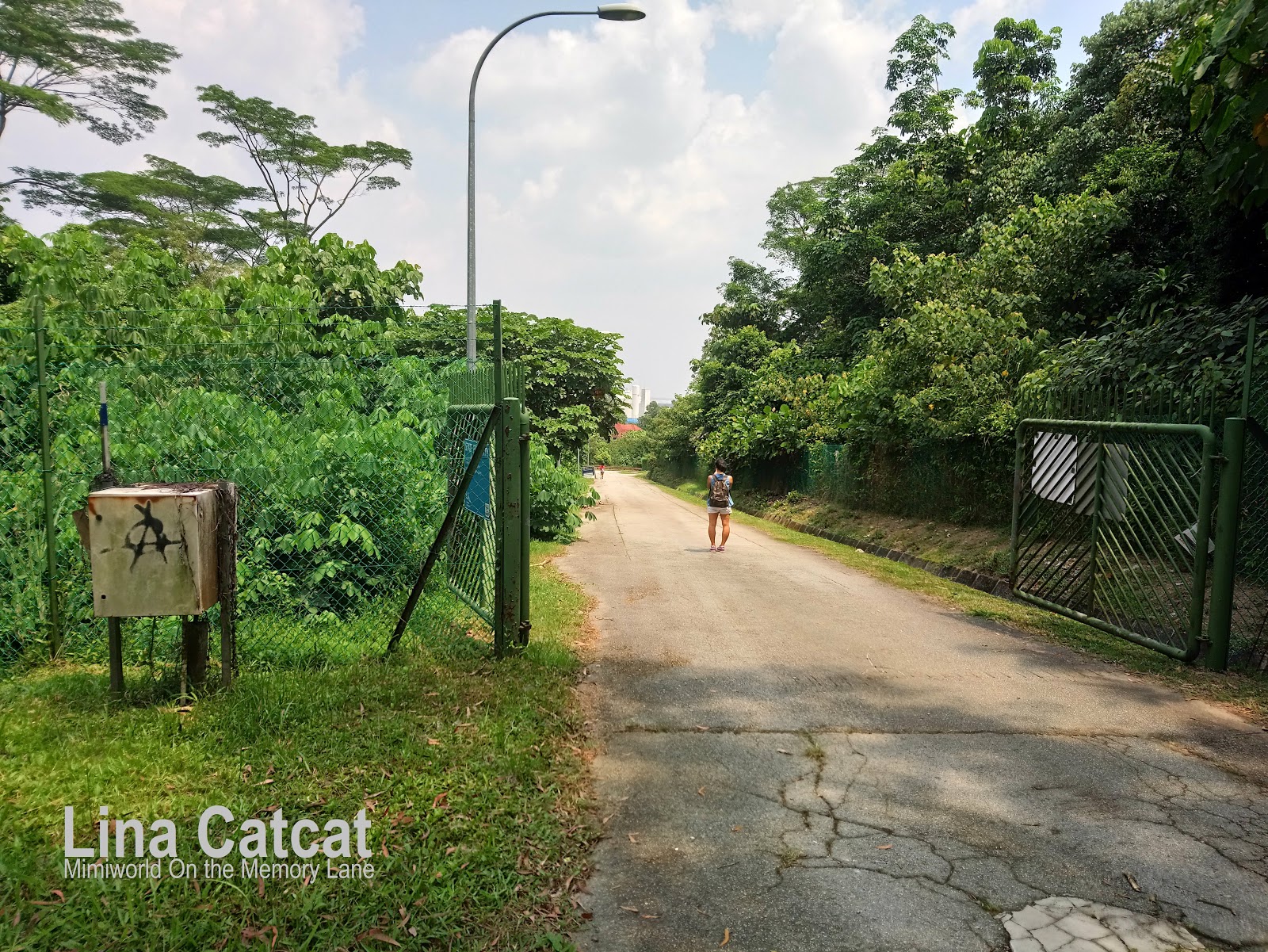
View Road to the former hospital
View Road connected by another roads - Hawkins Road and Rimau Lane in 1970s to 1980s which were defunct now. It is understood that in Hawkins road, there was Refugees' camp to house Vietnamese people (boat people) who escaped from their countries after the Vietnam Wars.
Former View Road Hospital (1975-2001)
View Road Hospital (used to be Police Quarters at that time) was located at View Road junction of Admiralty Road West. It used to be a medical complex in Singapore specialising in the treatment of patients with mental illnesses. The view road hospital used to be a subsidiary of Woodbridge Hospital (1951) also formerly Mental Hospital (1928-1951) now known as the Institute of Mental Health (1993 to present) and was closed down in 2001. In later year, the premise was converted into a foreign workers dormitory known as View Road Lodge in late 2000s. Previously known as "Batu Rimau Gurkha", the building was allotted by the British Bases Conversion Unit to the Ministry of Health around the late 1960s to early 1970s.
Floor plan of what looks like 'E' shaped
We arrived before 10am by cab from Admiralty Station it's because the North-South Line we took from Circle line, travelled so slow and it stopped abruptly a few times in between each station that took us longer time to reach our destination. Oh..gosh...we still have 15 mins more before 10am...so we decided to alight at Admiralty station instead of Woodlands station as it's not far from there in less than 10 mins by cab.
Posed a selfie with them from left (front) - Roszelan's daughter, Kamal, me and Harry. Behind  - Juneta and Roszelan (former resident at 10 view road)
 Quickie Selfie before the tour
As we reached, I saw lots of participants already there before us...So I quickie selfie with some of them before the tour, organised by Jerome, supported by SLA. Look how happy we were...
Encik Baharudin and Encik Roszelan
Two of the special guests, Encik Baharudin and Encik Roszelan were children who lived at 10 View Road with their fathers who were with Naval Base Police Force in late 1950s to around 1972, shared their childhood experience with participants at former NB Police Quarters.
Encik Baharudin's old passport
Former resident Encik Baharudin's old passport shows the address at View Road unit room 50, Police Quarters.
Encik Rozselan (Leqiu) pointed at his former home
Former resident, Encik Roszelan (Hang Leqiu) pointed at his former unit at level 3, unit room 55 while Encik Baharudin who also stayed at level 3, unit room 50.
Photo Group before touring
Spotted Hang Leqiu's hand pointing at!
Behind him is the Bomb shelter that built above the ground in 1940s during British rule. Once a Naval Base Police Force quarters in late 1950s to around 1971/72 where Asian policemen and their families lived. The Naval Base Police Force comprised of SIkhs, Punjabi Musalmans and Malays. During the time, there was a Sikhs temple - Naval Police Sikh Temple located within the compound. The Gurdwara Sahib Naval Police, was registered in 1960 by the Sikhs of the Naval Police Force. This Gurdwara later merged with Guru Khalsa Sabha in 1971, when the Naval Police Force was disbanded with the withdrawal of British military forces.
2 Floor unit room
Former NBP officers and its families lived each units
Former residents like Encik Rozselan and his families lived in the unit
In 1971, the British transferred the Naval Base at Sembawang to the Singapore Government. The Naval Police Force was also disbanded at this time.
Children played sports at badminton court
The badminton court (foreground)where the former NBP officers' children who played sports within the compound. 
The drain (far right) where the children played
On raining days, the children would play at the drain which stretched all the way to the main road. Well, I would think of the tadpoles showed up at the pond drain or the wet 'pond' fields where I used to collect tadpoles in my younger days.
Front entrance
In 1969, as Woodbridge Hospital reached a peak of 2,654 average daily occupancy and there was a need to relieve overcrowding at the hospital and the location of the serene surroundings of the building made it ideal for the Ministry of Health to set up a secondary 
institution there.

Used to be counter for Enquiries
When I stepped into the main building, the window grille I saw, used to be counter for Énquiries if I could remember and there is a door next to the counter that used to be "Ádmission".
Anti-suicide Stair Protection
I have seen many stairwell with anti-suicide stair protection in other places/countries, be it restaurants at old buildings, hospitals, lunatic Asylum building, old folks homes...etc.
Closeup: Anti-suicide netting
Anti-suicide stair netting protection was installed after the incidents over the years at the hospital.
Grilled gate locked for prevention
The grilled gate installed to prevent patients ruining up to the rooftop/watchtower, similar to one of my oldest uncles' 3-storey bungalow's spiral staircase on the 3rd level.
The watchtower
Selfie posed at the watchtower
At the watchtower, again I took a 'quick' selfie with these beautiful ladies - Louise and Catherine before going to bomb shelter which is on the ground below.
The empty field once the site of the old Swing
At the watchtower, I spotted the small 'empty' plot of field that used to be the site of '7' wooden board swings where the 'sick' patients seat on the wooden board if I could
remember. The '7' wooden board swings just next to the 'long' drain (longkang), located facing the main building (front) as if I could remember.

Lighting Conductor is seen at the top
In June 1972, the building was handed over to Woodbridge Hospital (WH). Concrete plans were then put in place in July 1973 to convert it into a secondary mental hospital, about S$700.000 project (relieved overcrowding at WH) for the rehabilitation of less severely-ill patients on their way to recovery, officially completed on 27 May 1975 and commissioned on 1 August 1975. The first batch of patients were admitted to the hospital on 4 August 1975 - 35 patients set foot in View Road Hospital, a psychiatric facility with 250 beds for the rehabilitation of patients with chronic schizophrenia. Ward 21 of WH was converted into a new psychiatric Outpatient Department while Ward 23 became a medical ward. Patients at the view road hospital would undergo a rehabilitation programme to learn some useful trade such as woodwork, laundry, tailoring, basket-making and toy-making, was expected to help them recover faster and form a pool of semi-skilled workers on their return
to society. It reported stated that the 3-storey building was renovated on the lines of
rehabilitation hospital rather than hospital wards.
In 1990, the hospital began to take in female patients and the following year, the hospital undergoing major renovations. By 1994, there were close to 294 patients housed at the
hospital.
Psychiatric rehabilitation has been carried out in View Road Hospital since 1975. The training and programmes have been developed over the years and were individualised according to each patient's abilities, handicaps and needs.
Ground floor at the left of the main buidling
There were 2 sick bays - the ground floor of the main building building would accommodate among other things, 9 rooms with 33 beds, 2 sick bays with 12 beds an administrative office, charge nurse/medical officers' office, a treatment room, a staff room, a barber shop and a large dining hall for 125 patients. The 1st floor housed 19 rooms with 89 beds, an area for craft work and a tailoring department, while the 2nd floor had 38 rooms with 128 beds. Recreational faculties would be provided. There was occupational therapy at the workshop connected to the left of the main building.
Used to be Offices
 The spacious hall
 Spacious Kitchen 
The spacious Kitchen which is inside the building at the ground floor.
Another Kitchen outside the building 
Kitchen shelter in the middle (foreground)
There are two sections of kitchen of which one is outside next to it along the kitchen corridor in between. The hospital chefs and cooks had to prepare meals so that the sick patients will get the food intake which they need to help with recovery.
In View Road Hospital was on work rehabilitation and social functioning so that the patient can adapt to outside life. Its success is reflected in the Day Release Scheme. Of the 250 patients in View Road Hospital, 92 patients were on the 'Day Release Scheme' that was happened to be one of my relatives who developed mental problem after his wife passed on. The 'Day Release Scheme' was to identify factors that contributed to the chronic patient's quality of life from both the patients' and staff's point of view. This included in any lack of congruence between staff and patient perception as these could have significant implications for planning long-term care. In 1997, 50 of the patients under the Day Release Scheme at View Road Hospital and the staff were given a modified questionnaire concerning the patients' quality of life.
View Road Lodge (2008)
This former view road 'mental' hospital converted into foreign workers' dormitory called 'View Road Lodge' in 2008 which I heard from an old friend (happened to be my primary school classmate) whose friend who was a lodge manager, in charge of view road lodge. There was some incidents like fighting among workers are very common...Here it went like this...."Most workers' dormitories have at least two burly, specially trained guards on duty at any one time. They will conduct spot checks every hour when there are workers around. Said his friend, lodge manager at View Road Lodge in View Road: 'You cannot employ any normal general worker to be a security guard at a workers' dormitory. You need someone who is fierce and can take control of difficult situations." But before that it was called "View Road Worker Dormitory" at that time after the hospital ceased in 2001. This former hospital has been managed by different operators and rented out for the workers' accommodation thru MOM.
former NB Police unit became Workers' room
The fighting among the workers are common...eg. When fights break out and cannot be stopped, the guards will first threaten to call the workers' employers. This tactic is usually successful as workers are most afraid of being repatriated. But if the fight continues, the police will be called in. Normally....the dormitory, which houses 3,000 workers, has never had a fight since it started operating years ago. Other dormitories prefer a simpler method of keeping peace: providing more space and better facilities.
Washing bay
The View Road Lodge managed by Tonga Engineering Pte Ltd (incorporated in Mar 2008 till July 2017).Tonga Engineering was to operate and manage foreign workers dormitory in Singapore for building construction industry, and also in partnership with expertise set-up tower crane leasing. The lodge allowed residents to install their own TV sets in their rooms so that they will not have to share the common set. Gambling, drinking, cooking and bringing girls back are all not allowed there. 
 Hindu Shrine outside at Bomb Shelter
Closeup: Hindu Shrine
They also built shelter for their deity (hindu god) outside at the bomb shelter which we saw it on that day during the tour supported by SLA. At that time, there was no Hindu Deity when it became View Road Hospital.
 An above ground Bomb Shelter (front)
An above ground Bomb Shelter (back)
The bomb shelter (Rimau Bomb-Proof Office 1941) surprisingly built on above ground rather than underground in those times. At the back of the bomb shelter which is toilet door.
 Spotted a spoon inside bomb shelter
Inside the bomb shelter, I spotted a spoon (below foreground) in the drain that was left by foreign workers when they moved out. What it has got to do with foreign workers inside the bomb shelter? Cooking inside the bomb shelter?
Lizard eggs on the wall
Spotted dozens of lizards eggs on the wall inside the bomb shelter.
 Exposed bricks wall
The door to the shelter rooms and toilets
we came in by the door
High ceiling inside bomb shelter
Generator room inside bomb shelter
fluorescent lamps on top of the tank
Spotted the fluorescent lamps on top of the 'red' tank, a table and a vintage Handsaw in the room.
Toilet door inside bomb shelter
Toilet door outside bomb shelter
The toilet door which is outside at the end of the bomb shelter
Sharing a toilet room?
There would possibly sharing a toilet during in crisis or whatever in cramped space. The bomb shelter would accommodate hundreds of people in each hall/rooms.
After walked about an hour and 45 mins, it's time for us to end our tour. My hubby left early before me and went back to his office to check on his foreign workers. As I was walking out of the gate, I took some shot of the gate and then I heard Harry calling out, I turned around....and then....Click!
Hooray! Harry jumped for 'joy' 
Hooray! Harry jumped high for 'Joy' after completed his mission, beside him is JJBB looked on, smiling...
Recent Signage
Trespassers left a mark
As I walking down the road, there is police's signage board that indicated in May 2017, 11 people were arrested for trespassing. That's how trespassers left a '2017' mark on the wall of the stairwell. So don't play play by entering the premise without warning. There is motion sensor CCTV and alarm sound that is monitoring the movements of intruders/trespassers.
The 'former' View Road Hospital is the last two series tour conducted by Jerome with supported by SLA. I am glad to be able to visit the former hospital that I used to visit in the past.