Tuesday, 21 June 2011

Order Out of Chaos

As I was received on confirmation booking from NHB's email about Order of Chaos trails of the Old buildings was conducted by a staff from NHB name Joyce and one of volunteers named Ms Jill Wong on 19 June 2011 in the morning at 10am. As I managed to reach at the bus-stop at the entrance of the IT Mall building as early before 10am. The three visiting place are Central Fire Station, Hill Street Police Station and Former Ministry of Labour Building (now as Family & Juvenile Court).
Firstly, I was about to meet Joyce, staff from NHB who conducted the meeting place and trails for participants and myself. There are about 10-12 participants including me and the waiting time for the rest a little late.
Central Fire Station
On the 1st trip is Central Fire Station which stands opposite the bus-stop where I stand and a volunteer tells us about the history of the Central Fire Station and how the Firemen worked through during their ancient times. Members of the public learn more about of the SCDF, the role of functions of the fire stations as well as the capabilities of its firefighters. It was gazetted as one of S'pore's National Monuments in 18 Dec1998.
A watch tower
Short Brief history of Central Fire Station: Built in 1908-09 by the Municipal Council of S'pore, the Central Fire Station was the first headquarters for the fire brigade. This building marked the beginning of the modern fire-fighting services and the change from horse-frawn fire-carts to motorized fire-engines. The Central Fire Station is only in-charge of the CBD and Chinatown area. Year '1909' can be seen on top of this building and it has been 100 years of operations since. Being part of S'pore's early oldest history, Central Fire Station has undergone transformations and stayed relevant throughout the years. The Station's iconic presence in the heart of the city serves as reminder of the key role it plays in keeping S'pore's Central Business District(CBD) safe from fires and other emergencies.
This Civil Defence Heritage Gallery is officially opened by Mr Wong Kan Seng, Minister for Home Affairs on 22 Nov 2001. Visitors to the Heritage Galley can learn about the civil defence's progression in S'pore through the years, with displays of antique fire engines and other firefighting equipment. There are customised interactive stations for a close-up experience of what fire fighters and rescuers go through during a mission.

Above photos: The exit doors and 110 ft watch tower

Above photo: Red & white building built in 1909 (as seen in picture)
The construction of the red and white of the fire station was built in 1909 (as shown in pic)The contruction also prompted a modermisation of the brigade's equipment with motorised fire engines being introduced, which is evident in the carious size of exit doors of the fire station. The station, with its distincitive red and white brick facade, a style described as 'blood and bandages', and also features a 110 ft high watch tower, which was the tallest structure in the city when it was built, providing a vantage from which a 24hr watch could then be kept over the city. It also served as a hose drying tower - a feature in many fire stations. The station was later expanded with a new wing added as well as quarters expanded on land pruchased at the corner of Hill Street and Coleman Street from the Chinese Girls' School which was then moved to Emerald Hill in the 1920s.
Statue of Firefighters
This sculpture (above) is proudly sponsored b the National Fire Prevention Council. In recognition of the fire fighters and rescuers who risk their lives and go beyond the call of duty in protecting and saving lives and property for a safe and secure and Singapore. This sculpture can be seen at the near Galley outside the building on the left.
Do you know that all fire stations across Singapore, except Jurong Islands Fire Station and Changi Fire Station, are opened to the public every Saturday from 9am to 11am as walk-in visitors and no registration is required.

Hill Street Police Station and MICA's entrance
Second trip is Hill Street Police Station (above), the Old Hill Street Police Station building is the site of Singpaore's first jail. and was built in Neo-Classical style which was still fashionable for the public buildings in England in the 1930s. The Neo-Classical style is commonly seen in municipal buildings in S'pore and has features such as symmetry, the use of columns and pediments such as seen over the main entrance of the former Hill Street Police Station.
The building was designed by the PWD when Frank Dorrington Ward was the Government Architect. The six-storey building has a thoroughly Italianate air with its corbelled loggias and balconies, arcades, stuccoed, rusticated surfaces and central courtyards. The building when built, was an imposing structure which was described as 'skyscraper' was in fact the largest structure in Malaya.


Brief history of Old Hill Street Police Station (1934): The Old Hill Street Police Station stands on the site of S'pore's first jail and was site began in the 19th century when the Assembly Rooms of the S'pore Town then, was built and Hill Street Police Station was redeveloped in 1934 as the police station and barracks. During the Japanese Occupation, it was used the holding area for the Japanese secret police, the 'Kempaitai'. After the war, the building once again was used as police station. The Arms and Explosives Branch of the Police Department operated there from 1949 to 1981. The S'pore Government had introduced a housing scheme to accommodate police officers and their families and barrack-like accommodation lost its attraction.
Today the Old Hill Street Police Station Building is occupied by the Ministry of Information, Communication and the Arts, MICA, and is therefore known nowadays as the MICA Building in 2004 (above pic). Also occupying it is the National Arts Council, National Heritage Board and the Media Development Authority that moved into in Apr 2000.


Above photos: The two courtyards
The building featured two open courtyards (now enclosed by a glass roof) and numerous windows that I can't help noticing that opened to the outside and inside of the building as well as the courtyards, giving the rooms in the building a airy and bright feel. Sources says that there are total about 911 windows but according to Ms Jill (volunteer guide) who says that this is not correct and what do you think? Shall we ask the historians who knew about this building or look through at NLB?

The once open-air courtyard of former Hill Street Police Station is now encased by a glass roof. A feature of Frank Dorrington Ward's designed building is the light and airy feel in interiors centilitre and brightened by generous windows which even in the less colourful days of the building, never goes unnoticed.
Last not least, below is the article, extracted from the Straits Times dated back 24 Sept 1890, the outbreak of fire occurred in 'Hocklam Street'.
About 9.30am, a fire began in a house No. 8 Hocklam Street, and a crowd immediately commenced to gather and found that they the pleasure of watching a fire work its own way without let or hindrance. Very soon Chief Inspector Jennings arrived, and pending the arrival of the fire engines did all he could, that is, watched the crowd. At 10 o'clock the fire had obtained complete possession of the house, and the flames lapped round the casements and mounted high into the air illumination the whole town.
The article goes on to describe how the crowd had admired the uniform of the uperinterndent as he watched on horseback as the fire made its progress, with water arriving only an hour after the fire by which time No. 8 & 9 were 'completely gutted' and added that the "organisation did not know where the nearest hydrants were situated" in spite of the "barracks of the Fire Brigade" being "in the same street as, and exactly opposite to, the unt houses".
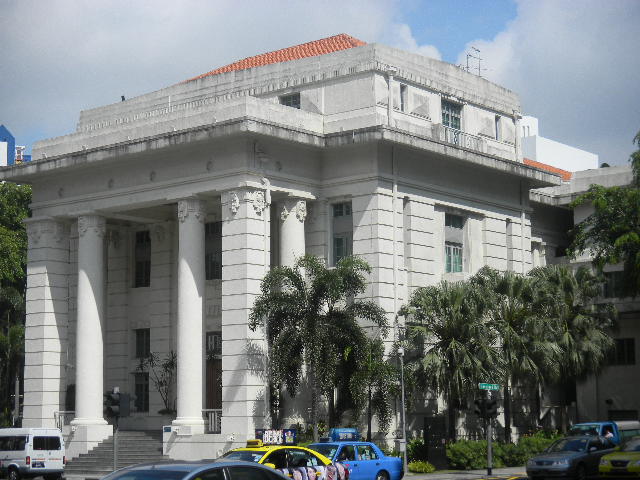
Former Ministry of Labour
The last trip to Former Ministry of Labour, currently houses the Family & Juvenile Court of the Subordinate Courts of S'pore. This Building stands on the site of the former Chinese Protectorate Building which was established in 1877 to protect and control Chinese immigrants to S'pore. This building has been restored is now used as the Family and Juvenile Court of S'pore.


Above photos: Sign Board and Entrance to FCJC
Short Brief History: Was built as a grand Neo-Classical Building in 1928, the former Ministry of Labour Building is used by the judiciary and has been refurbished in 1930, the building housed the Chinese Protectorate which was set as an intermediary between the government and the Chinese community. Their role was to look after the welfare of the Chinese community, its work involved fighting the exploitation of prostitutes and coolies by their agents, the regulation of Chinese societies, and the control of triads.
In early 1877, the government set up Chinese protectorate and employed William A. Pickering who was the familiar with Chinese cultures and understood the problems of the Chinese community. William was the 1st Chinese protectorate to improve the welfare of the Chinese community and was popular amongst the Chinese. He retired in 1888 after a near-fatal attack by the secret society member. The Chinese Protectorate still functional until the outbreak of WWII and after the war, it was taken over by the Ministry of Labour and Social Welfare and later, Ministry of Labour & Law.
Not long, the former Ministry of Labour was gazetted as the national monument on 27 Feb 1998.
Statue of Family

These sculptural figures, designed in the minimalist style and cast in bronze, represent an ideal family bound together by love, mutual respect, and concern. Intentionally abstract, they transcend racial identities. Each figure stands as an individeual. Together they reflect the harmony and balance of a family unit.
The mother figure, compassionate yet firmly grounded, is bending forward and looking towards her children. The father, slightly more formal, is bending his knees as an accommodation towards the viewpoints of the other family members. The growing boy is close to his father, reflecting the importance of paternal influence is the raising of youth. With his hands in his pockets, the boy appears to be saying. "I'm all right, ma and papa. I'm part of this family." A very cute figure, the little girl with pigtails has her arms raised as she is about to be picked up and hugged as affection is care to the family.
In portraying this family scene at the entrance to the family and Juvenile Court, they are conveying the high regard they place upon protecting family obligations, promoting familial ties and upholding the values restorative justice in their Family and Juvenile justice models.
Well, I have to pen off here and look forward to the next chapter,

Sunday, 12 June 2011

My Journey to Sri Mariamman Temple


Sri Mariamman Temple & Gopuram Tower (2nd pic)
I wonder if I shall go to the oldest temple in S'pore, in the heart of Chinatown when the private bus was passing by and I spotted the temple just opposite the road where newly bridgegroom was there. I quickly alighted at the bus-stop and saw the oldest temple named 'Sri Mariamman Temple, was built in 1827. It has played an important role in the lives of Hindus here. In the early years, it provided shelter for Indian Immigrants, and was the only Hindu temple whose priests were vested with the authority to solemnise the marriages.


Bridegroom at solemnise ceremony

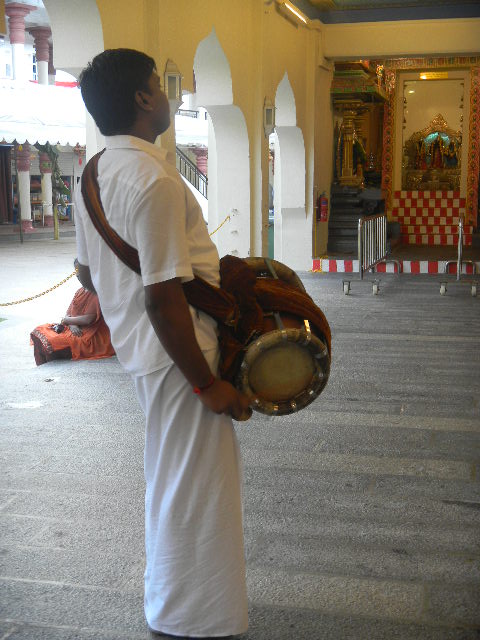
Musicians on solenmise of marriage of a Bridegroom
I spot and captured the musicians standing on the left side of the hall facing the Sri Mariamman where the Bridegroom stands.
The temple is dedicated to the Mother Goddess Mariamman known for her power in curing epidemic illnesses and diseases. The temple attracted many devotees, who turned to her powers of healing. Sri Mariamman Temple was established by Narayana Pillai, who came to the settlement with Raffles' party in 1819. In 1823, Pillai requested for some land to build a temple, but it was only in 1827 that the 1st temple building was erected. The temples most outstanding feature, the gopuram or entrance tower (see top pic) built in the South Indian Drevidian style, dates from the 1930s. The gopuram rises above the main entrance along South Bridge Road. The present 6 tiered gopuram was built in 1925, was repaired and restored with an elaborate proliferation of scuptures in the 1960s. Sri Mariamman Temple was gazetted a National Monument on 6 Jul 1973 by PMB.


Above photos : Priests in prayer and Goddess Mariamman
The priest is holding prayer at the sanctuary of the bridegroom's marriage which is shown on top of picture.The Main prayer hall is the central shine of Mariamman, which is franked by the shrines of two secondary deities - Rama and Murugan. The main prayer hall is surrounded by a series of free-standing shines, housed in paviion like structures with decorated dome roofs, known as 'Vimana'. These are dedicated to the following deities: Durga, Ganesh, Muthularajah - also known as Mathurai Veeran, a rural Tamil deity, Aravan and Draupadi.
Painting (Frescoes) on the ceilings of the shrine as I look back towards the entrance. (pic above)

Above photo: Flagpole pillar and the bell & drum

The Flagpole pillar is on the side of the courtyard and in relation to the 'gopuram' tower entrance. And the bell is on the left side of the pillar.
Short Brief history of Narina Pilliay: He was the 1st Indian and Tamil Pioneer of S'pore; accompanied Stamford Raffles whom he found him(Pilliay) a dependable, honest and versatile person that Raffles brought him S'pore in 1819; the 1st brick maker and building contractor of S'pore, the earliest Indian community leader of S'pore. Pilliay opened a shop sold cotton goods and later was caught fire in his shop and was bankrupt in 1922. Raffles helped him to restore his fortunes and was clear evidence of Raffles's concern for the tamil pioneer. In early 1823, Pillay obtained his present site to build the Sri Mariamman Temple in South Bridge Road. Actually the 1st site was offered by the government for the Temple was in Telok Ayer Street but there was no fresh water close to the temple.
About Goddess Mariamman - Sri Mariamman can be traced back in 4000 years ago to the Indus Valley civiization of Mohenjo-daro and Harappa in North West and it is believed to be a Dravidian civilization. Sri Mariamman nouishes and protects all beings and is assoicated with rain; she gives life, nurtures and sustains it. She is the source of all energy without which nothing moves in this world; she has various forms which describe her attributes in elopquent appearances.
Deities with sacred cows
The top of the boundary wall that surrounds the compound is lined with sculptures of cows (considered sacred by Hindus)Today, Sri Mariamman temple is best known for the fire-walking ceremony, or Theemithi, that is held every October or November. Devotees would walk on hot coals as a test of their faith and devotion. It is said that in Apr 2010, the temple was re-consecrated following the completion of a S$4M restoration project. A team of about 20 artists were brought in from India for the project, which included repairing all the stone deities.

Friday, 10 June 2011

Journey to Changi Museum

After a few days of rest and relax at home, on the night before, I discussed with my hubby that there is a 'free' admission to a museum called Changi Museum where the battlefield took place and held hostages of POWs(Prisoner-of-war) by the Japanese, along chapel church at Upper Changi North which stands at the foot of the hill roadside among the private estates.

As my hubby and I reached there at about 1pm on 4th Jun 2011 by public bus from Tanah Merah Mrt which takes about 15 mins or less depends on each bus stops if no one is at the busstop or alight! My hubby waited patiently for me at the bus-stop because his office is nearby the Museum!

At the entrance of the Museum, I saw the Chapel Church next to the museum. The site of many Prisoner-of-war camps during the Japanese Occupation, Changi has since gone down in history as a place of much pain, torture and human suffering. It is said that more POWs perished under incarceration that in battle itself. Whether it is on the Death Railway or the countless labour camps in Japan and Formosa (Taiwan), the Changi WWII trails commemorates the fight of brave men and women during battle and in internment.

The Changi Museum is dedicated to the Prisoners-of-war (POWs) and civilian internees who were incarcerated in S'pore during WWII. The Museum honours the memory of many who faced adversity with spirit and commitment. It inspires visitors like us with stories of courage and sacrifice that occurred during those painful years.

Above photos: Prison door and domestic radio (Japanese)
I noticed the unusual door which is very old style during Japanese Occupation, called Prison Door. I believe this door was used in Changi Prison in those days during WWII. And the domestic radio, it is said that this radio required to be locked on approved frequencies so as no one would listen to BBC news and other foreign broadcasts. Failure to comply would result to severe punishments. This is cruel for civilian people who had no chance to communicate or listen to.
On further down the hall, I noticed the board stated:Mariners Memorial (1939 to 1945), it is stated that "The thousands of men and women who lost their lives in these waters during WWII in the defence and liberation of the territories in Southeast Asia occupied by the Japanese. They were sailors submariners naval airmen and marines or the British and allied navies and merchant seamen or many nations whose ships were engaged in the conflict name "The Forgotten Fleets' are remembered here by their comrades, their sacrifices were made for our freedom."
As I strolled along the hall, many artefacts are display on the wall as to remember the heroic soldiers of Malaya Regiment and British.Army for defending in S'pore.
At last but not least, I bought some books titles"To Japan To Lay A Ghost" cost about S$25 at the end of the hall is the counter that displays historic books and others. This story is told by the Author Peter S. Rhodes who was born 1919 was studied Architecture at the University of Liverpool from 1936 to 1939 when, the outbreak of war, he became a gunner surveyor. He was taken prisoner at the Fall of S'pore. After the war, he changed his occupation eventually become a Chartered Structural Engineer. In 1968 he became Chief Structure Engineer and he retired in 1983. A well read book about his life during WWII.

Well, I have to pen off here and looking forward to the next chapter - ArtScience Museum.

Thursday, 2 June 2011

Journey to Reflections of Bukit Chandu

After my writeup about my journey to Old Ford Factory in my blog which you may have read about it. This hertiage factory is full of history revealed in connection to the Reflections of Bukit Chandu where the battlefield documentary dated back from the start to the end of the war. This centre (RBC) was developed in commemoration of heroic actions of the Malay Regiment who fought valiantly against the Japanese Imperial Force during WWII while defending S'pore.
As I reached Bukit Chandu at about 3.40pm after I left from the Ford Factory. I took a bus from Habourfront centre/Vivo City bus stop to reach there about 10 mins after transferred from Clementi Mrt to Harbourfront Mrt.
Signboard on top Mrt Flyover

There I saw the signboard on top of the flyover just opposite the road to the small road up the slope hill to make a curve to the right. Luckily, a kind soul driver (lady) oblige to give me a lift when she saw me as she also takes the same route as me to reach the hill of Bukit Chandu. Actually the walkpath on the side road would take about 10 mins to reach there.

Above pictures: Signboard (left)Staircase to RBC(Centre) and Reflections of Bukit Chandu(Right)
On top of the hill, there is a carpark leading to the staircase which stood the Signboard inscribed on a stone: 'Reflections of Bukit Chandu (RBC)" , I asked her to alight me there as I would like to walk around there followed by the staircase to the Reflections of Bukit Chandu where the building stands on top of the hill. The kind lady driver then drove up to the side of the hill that leading to Kent Ridge park next to the Bukit Chandu. I would feel relaxing at the top of the hill with flesh air with lots of trees/carparks surroundings.
Statues of Malay Regiment
Amidst the lush greenery of Bukit Chandu (formerly known as Opium Hill) off Pasir Panjang Rd, is a WWII interpretative centre developed and managed by National Archives of S'pore. Discover the story of Askar Melayu - Malay Regiment soldiers who valiantly fought in the Battle of Pasir Panjang, and reflect upon the universal values of courage, loyalty and honour through the stories of people who gave their lives to defending S'pore.
Reception
Inside the Bukit Chandu museum's entrance, there is a reception counter and there are 2 levels of which the story revealed in Gallery I to Gallery III about the battlefields of Malay Regiments. Learn about the reason why Malaya was embroiled in the war and also re-visit the painful memories of war through interviews with relatives of Malay Regiment soldiers who lost their loved ones in battle.

Above pictures: Map of the war, Army Binoculars (Japanese) and Field Communication Headset (British)
These artefects shown on display was used during Occupation where Army Binoculars was used by Japanese, is made of aluminum and covering is a mixture of sand and black paint. The field of view of this binoculars is possibly around 10 degrees; 105 meters at 1,000 meters. And the Field Communication Headset was used by British Army is a device to communicate between field units. The British had better communication equipment than the invading Japanese forces, But the British had failed to capitalise on such technical advantage.
Story of Defence of Malaya
In Gallery I, how the WWII began in Malaya which details the socio-political climate of the Malay Peninsula in the late 1930s and Japan's invasion plans.
Battle for S'pore
In Gallery II, see the Battle for S'pore unfolding before you through a multi-media presentation that details various battles leading up to the British surrender on 15 Feb 1942.

Battle of Pasir Panjang thru' the pillbox
In Gallery III, is the Battle of Pasir Panjang is told through their virtual host, Corporal Din. Peer into the pillbox and see the epic battle replayed before you, with a touch of the Pepper's Ghost Effect.

As I walked through the door ' Battle of Pasir Panjang', where I would see the 'Tiger of Malaya' - Gen Y. Tomoyaki statue stands on the left. Walked up the staircase of Gallery in level 2, I see the signboard indicated in Galleries: Windows of Memories, Well of Reflections, Bukit Chandu Theatre and Learning Room.

Staircase leading to the level 2

Above pictures: Well of Reflections & Learning Room
As you look into the "Well of Reflections" to see yourself amidst the destruction and horrors of war, or stop and look through the Window of Memories filled with tales of heroism and courage.
Helmet & Rifle
Rifles and tools
As I step into the Learning Room and discover more about weapons and other WWII paraphernalia. As you can don the cast iron helmet and inspect the emotions of the soldiers as they fought in the front lines of battle.

I noticed there is a kerosene lamp (above) was used during the battle at nights.

Above picture: Bukit Chandu Theatre
Next at the Bukit Chandu Theatre, to re-capture moments of the gruelling battles that were fought in Pasir Panjang and had experience the "Sounds of Battle" through a Binaural Sound Presentation. With special headphones and low frequently speakers, experience the thunder of gunfire in the same impenetrable darkness that engulfed soldiers during battle.

Above photos: An Office, Canteen & Vending Machine

As I further walked at the back of the door, told by staff that leading to the office, small canteen and a toilet, there is also a vending machine that sells drinks with a few coins slot into it. The place where the staffs enjoy coffee and relax at breaktime.
Garden
There is a garden with its fruits and heritage trees, is a delightful change from the hustle and hustle of city life. You can venture to Canopy walks that links Bukit Chandu to Kent Ridge Park by leisurely stroll amongst the tree tops and learn more about the landscape of the Pasir Panjang historis district or venture further to take in the panoramic views offered by the Southern Ridges 9km stretch of green and open space.