Ex-residents still frequently visit Kampong Buangkok to reminiscing nostalgia they have for the kampong back then. Kampong Buangkok is well known for its racial mix of Malay and Chinese residents who were able to live together without much conflict. At that time in 1960s racial riots between Malay and Chinese that had happened. But during the period of unrest, the residents of Malay and Chinese living within Kampong united as one to live peacefully without the intrusion of outsiders. Most interesting is that both parties (Malay and Chinese) had agreed not to ruin their close ties and friendship they shared despite of the controversy that had happened outside their village. In 1960s, there were 40 families living in the village, and modern amenities such as running water and electricity were installed in 1962.
Despite the construction going on, on the site, we still proceeded to go along to catch a glimpse of the last Kampong Buangkok before it's gone.

Participants gathered
The leader of the group, Mr Faye taking an attendance of the participants and thereafter Encik Tuah made a short briefing about the program of the day and a little history of Kampong before embarking on our journey to Kampong Lorong Buangkok. It was an indeed overwhelming, to attract over 60 participants joining the trail and it was a huge success. This is something people who love to visit the kampong life and willing to learn more about their heritage and livelihood, and those who had lived there before! This is not my first time there and I had been there a few times in the past and my last visit was four years ago.
Sungei Punggol river
We set our journey at 9am sharp and reached Lorong Buangkok about 9.45am towards Sungei Punggol river.
Encik Tuah and his storytelling
Minutes later, we reached at the forest that leading to Kampong Lorong Buangkok, just behind Encik Tuah where he told a storytelling about flooding and thus earning its nickname "Kampong Selak Kain," a video by Singapore Tourist At Home, about the kampong prone to flooding and the residents of Kampong Buangkok hitching up their sarong wading in water up to their knee-deep. In 1976, there were 40 Malay families affected in flash flood at Kampong Buangkok in Yio Chu Kang.


The Kampong Buangkok currently houses 18 Chinese and 10 Malay families. It seems inevitable that the last Kampong - Kampong Buangkok could possibly soon its fade demise and some house in Kampong Buangkok would be preserved for its rich history.

Hitching up sarongs seen in kampong
Source: NAS
I remember there was a flash flood at Jurong at that time where my late grandma's village was, used to be flooding area within the forests that leading to her Kampong and the swampy area that was hardly to walk pass. Me and my cousins had to hitch up our dresses or pants to wade thru the murky water that level up to our knee deep or lower depending of the flood level. Those were the days, we used to play in murky water when we were kids back then. 
Beng Tang in green shirt
Then after Encik Peng Tang with his rich knowledge of botany and edible plants made a short speech about the plants and leaves.The Kampong Buangkok currently houses 18 Chinese and 10 Malay families. It seems inevitable that the last Kampong - Kampong Buangkok could possibly soon its fade demise and some house in Kampong Buangkok would be preserved for its rich history.

A path on a forest walk to kampong
We walked thru a grass path on the forest walk to the Kampong Buangkok, thru thick forest similar to my late grandma's villages that there was no light and electricity in the past.


Surau Al Firdaus
The last kampong mosque - Surau Al Firdaus at 23-C Kampong Lorong Buangkok where the Malay residents of Kampong Buangkok would visit the mosque for Friday prayers and other activities.

Band Member Encik Ariff (left)
We passed by resident Kampong Buangkok Encik Ariff's house who is an avid Band Member, regularly jamming and rock with my friend, Encik Nen Fatah many years ago.
Pakcik Awie(Village headman) and Tuah
A kindred Pakcik Awie of 82 year old, was born in Pulau Ubin, he is the Village Headman or 'Penghulu' of Kampung Lorong Buangkok, share his experience and sessions with us about the life in Kampong Lorong Buangkok in 1956 at that time. Back then, the payment of rental was S$13 per month and still it is today. It has been very informative and heartwarming recollection of life in the village of Lorong Buangkok has changed dramatically starting from 1956 to the present day and there is a construction going on recently.
'TREE' Group with Village Headman Pakcik Awie
Photo credit: Tuah Bugis
Thereafter, we took a group photo with Pakcik Awie who is happily to be photoshoot with us.


Encik Ah Soon and Tuah
In the meantime, I saw Encik Tuah talking to the Land Owner who addressed himself as Ah Soon, the brother of Mei Ong. According to Encik Ah Soon, told me that he has lived Lorong Buangkok for 6 decades when he was young boy at that time. I presume he is about 74 year old. He also told me in mixture of dialect and Chinese that if the government acquires his house and the land, he is prepared to move out of his kampong Buangkok home when the time comes. And he said 'No choice.' I am aware that the government will hold full authority acquire the land for specific purposes through the compensation to the owners of the property under the LAA (Land Acquisition Act). I heard that online petitions have been started against the possible demolition of Kampong Buangkok after the news announced in Jan 2009.stating that it will be developed into a place with housing, schools and other neighbourhood facilities.


Walkway between two kampong houses
Current residents of Kampong Buangkok who have experienced kampong living and some people who have no prior kampong living experience unlike my late grandparents and my late parents-in-law who had experience living in kampong life in China when the 'long' civil war and Kuomintang broke out in early years in 1900s to 1940s, thus fleeing to Singapore and other countries to settle and rebuilt their village houses in swampy areas and thick forests.

Zinc roof on the ground
Current residents of Kampong Buangkok in the hopes of maintaining their homes to be more liveable. they do carry out simple restoration works. Renovations done by tearing down its wooden roof and wall by replacing metal and brick. It was the fourth time in 2015, such modified house out of 26 homes and it is cleared that the roof was termite-infested and had to replace it.


kampong house at 43D (then 2012)

kampong house at 43D (Now 2016)
 Traditional Wooden Clogs
 Antique Shoe cabinet
Do you notice the old zinc roof at the above photo taken in 2012 before replaced a new zinc 'red' roof at 43D Lorong Kampong Buangkok? There was no wooden clogs placed outside and also the shoe cabinet was not there at that time. The pots of plant had moved to other location.

Well, I spotted traditional wooden clogs that reminds me of my kampong days and that wooden clogs I wore at sago lane where my late godma (b1908-2005) lived in early 1950s when I was in the my teen years. These clogs made loud noise especially at nights when they came home late while others asleep! That made people quivered the most.

Seeing this antique shoe cabinet that reminds of my godsister's parent home when my family and I visited early this year on CNY. They have this antique cabinet for TV too.
It is understood that one of the Kampong houses at 43D is conserved as a part of its history. In front of the kampong house, there is a poster pasted above on the pot of plant indicated that "No filming is allowed" and so... photography is allowed. Giggles..


It is understood that one of the Kampong houses at 43D is conserved as a part of its history. In front of the kampong house, there is a poster pasted above on the pot of plant indicated that "No filming is allowed" and so... photography is allowed. Giggles..

Kampong house at 45D (then 2012)

Kampong house at 45D (now 2016)
I was wondering about this house at 45D as if I was there in 2012 and I remember there was no sofa chair at that time but lots of household facilities within the house and the opening wooden parapet above the wall of the kampong house. The house has been repainted and the opening wooden parapets above the wall on the roof wide veranda had been covered with sheets to prevent rainwater coming in. As if the owner of the house had cleared up all the household equipment, repainted wooden windows and wooden door, put the sofa chair for the 'expecting' visitors to view their clean house.
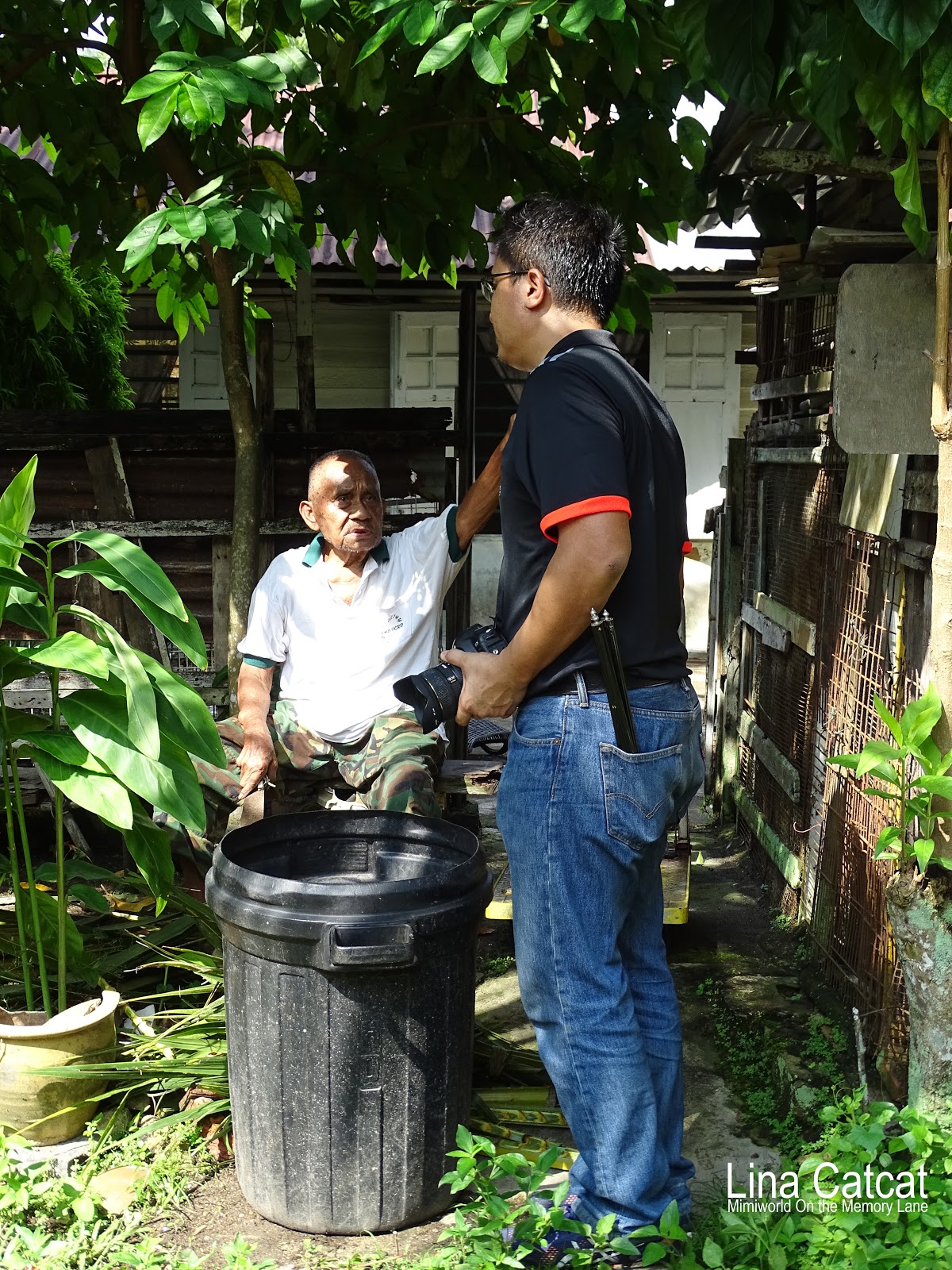
Encik Omar and Tuah
Encik Omar, the resident of Kampong Buangkok, is about 72 years old. He has 2 sons both living outside of kampong but they come here on weekends to tend to their father's needs and relax 'kampung-style'. Encik Omar was seen clearing fallen leaves littering his lawn to be thrown to the black bin for NEA truck collection of garbage.

Flood Marker
The main entrance leading to the kampong Buangkok where the flood marker is located below the drain. The flood marker is a must to all the residents at Kampong Buangkok.


TanTengTeng with her insights of leprosy home

Former Silra Home at 18 Lorong Buangkok
Photo by Author
Formerly a rubber estate removed from the Municipality, the asylum was called the “Singapore Leper Asylum” and renamed Trafalgar Home in 1950 at Lorong Buangkok. Relocation has always been part of the history of leprosy in Singapore.

Front of former Trafalgar Home at Lor. Buangkok (2005)
Photo by Author
Not many people know that there was once used to be leprosy colony next door for its neighbours, the 45-year-old Singapore Leprosy Relief Association (SILRA) Home that were housed many lepers at that time when it opened in 1971 at 18 Lorong Buangkok, were relocated to new premises at 80 Buangkok View on 10 September 2005. The SILRA provides food, lodging, recreation and healthcare services for ex-leprosy patients. It also teaches the patients some handicraft skills and rehabilitative work. Well, many years ago one of my relatives' daughter who had this disease (Hansen's disease) but she was kept at her home instead of SILRA, to prevent spreading by other patients who lived there for long. And she was taken care by home doctor because she was not used to adjust to this place. Eventually she was cured with standard antibiotics..


Hibiscus flower at Kampong Buangkok
Hibiscus flowers grow on shrubs or trees that can reach 15 feet tall and are sometimes called rose mallows because they are members of the mallow plant family. It attracts hummingbirds and butterflies. It also represents delicate beauty, unity and peace in their home at Kampong Buangkok and other parts of Singapore. The hibiscus flower has five petals that each represent a different quality and come together to represent ultimate peace. My mum has this flower in her small garden.
Photographer of the Day
Meanwhile...the photographer Encik Nen Fatah in action seriously while the other...

Male Model of the Day - Encik Saniroz
cool one - Male Model of the Day at Kampong Buangkok goes to... And sorry...if I left out the rest...well, I will be watching out for you, so be prepared.

Lor. Buangkok explorers photoshoot
We have walked within Kampong Buangkok compound almost 2 hours and had a wonderful trail with TREE group and congenial to the residents whom we had chatted and learned their livelihood of the Kampong spirit.
Kampong cat on the fence
Well, this Kampong cat reminds me of my beloved cat 'Mimi' that lookalike. Before I go, I bid goodbye to the cat after I took a photo of him.

Bus-stop@Yio Chu Kang rd
Finally, I took a bus home along Yio Chu Kang road from where I was alighted at the opposite road near once the 'Shell' petrol station (now ESSO station) four years ago. Times passed so fast and everything changed over time.

Blue Collar Kingfisher
At last, but lucky...I saw a blue collar kingfisher perched on the branch tree next to my block upon reaching to my home. Phew!