Map of Hainan Village@Upper Thomson road
Photo credit: Nee Soon Community
Above the map of the Ruins of Hainan Village along Upper Thomson road to the farther opposite road where there was once a village called Hup Choon Kek Village (now housing estates) but we didn't venture the area from where they stood just behind the forests.
In early years, Nee Soon district developed into an extended settlement as Chinese immigrants (China) were hired to become labourers in the rubber plantations. They later settled down forming villages, paying a token amount for the land they rented from Nee Soon. The villages include Mandai Tekong Village, Nee Soon Village, Hainan Village, Hup Choon Kek Village, Phua Village a.k.a. Heng Leh Pah Village, Kum Mang Hng Village, Kampong Telok Soo and Chye Kay Village.

In early years, Nee Soon district developed into an extended settlement as Chinese immigrants (China) were hired to become labourers in the rubber plantations. They later settled down forming villages, paying a token amount for the land they rented from Nee Soon. The villages include Mandai Tekong Village, Nee Soon Village, Hainan Village, Hup Choon Kek Village, Phua Village a.k.a. Heng Leh Pah Village, Kum Mang Hng Village, Kampong Telok Soo and Chye Kay Village.

Behind them was Hup Choon Kek Village (overgrown vegetation)
The site of former village - Hainan Village...something rings a bell, it sounds familiar, I recall clearly. My best friend of 30 years, her family and her relatives are Hainanese (Hailam) people and her father's oldest sister who still lives in Hainan Village (Haikou) in China when they visited her in 2014 and her structure home and the walls that are built in volcanic rocks, cement as well as red bricks that surround the house, even the staircase, toilets similar to the former Hainan village in Sg. So... are they related to this place before they moved to Margaret Drive in late 1970s? My friend's dad was born in Haikou, Hainan Village, China. When he was a toddler, he was carried by his elder brother or uncle came to Sg, I couldn't remember much. I was told by my friend a long time. One of these days I will ask her dad when I have time. I still remember my mum's two long time friends who are 'Hainanese' (Hailam in Hokkien) sisters too.
A short brief history:
In 1936, a famous Hainanese named Mr Han Wai Toon bought a piece of land along Upper Thomson Road where he build a garden named “Silly Fun Garden (Yu Gu Yuan)”. The garden was subsequently converted to a Rambutan plantation. Remnants of this plantation can still be found at the site today. The Hainan village was abandoned in 1975 when the government issued plans for the future development of the area.
One of the former Grandstands
Photo By : Sarafian (Tuah)
 Singapore Grand Prix 1960s
Map Credit: Google Maps
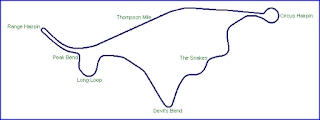
In 16th and 17th Sept 1961, the first Singapore Grand Prix was held in the Thomson Road circuit. The 3-mile long (about 4.8 km) circuit’s most distinctive stretch was a series of four bends called Snakes and a rounded V-shape called Devil’s Bend, covered the stretch of Old Upper Thomson Road from Sembawang Hills Circus to the other end where it met Upper Thomson Road and continued along this road until it reached Sembawang Hills Circus again. This bend was also the most dangerous turn of the circuit and the Thomson Road circuit was reputed to be one of the most dangerous tracks in the world.
We took a photoshoot group of one of the former "kampong" Grandstands before we proceeded further down the forests.

Map Credit: Google Maps

A lap of Upper Thomson Road Circuit
Map by VR- Zone
Due to numerous road accidents in the past, the race was discontinued or banned from 1973/74 onwards, the part due to the problems of managing the increased traffic and the recent fatalities.
After a long absence of 35 years, the motor racing event finally revived as Singapore F1 in Sept 2008, the first ever Singtel Singapore Grand Prix held in Marina Bay street circuit.


The road was once called "Hairpin" because of the shape of the Snakes and a V-shape Devil's Bend as far as I know and heard from one of my oldest uncles in his 80s. My mum and her friend had an car accident along Upper Thomson road late at night in late 1980s. Her friend's car flipped multiple of times and miraculously she survives with no injuries only her head bumped a few times because she wore her jade pendant of Goddess Kuan Yin broke into two that saved her life whilst her friend (driver) sustained injuries. You may watch video (above) on how the road look like while driving...

Staircase leading to one of the Grandstands
The main Grandstand that used to be covered with roof verandra kampong style.

The Ground of the Grandstand
The preparation of the ground where we (TREE explorers) walked.. were all done by members of the Work Brigade. The main grandstand where President Yusof sat was situated at Sembawang Hills Circus facing the Hairpin. President Yusof attended the final day every year. There were Grandstands at the Snake, Devil's Bend and the start and finish which was at Upper Thomson Road somewhere where Looi's Motor used to be located, now moved to Kaki Bukit Road Place. The vehicles proceeded in a clockwise direction. The Grand Prix was usually held over the Good Friday weekend. Friday was for trials. Race days were on Saturdays and Easter Sundays. The Saturday races were divided into various categories for motor cycles and saloon cars.
You can watch the video (above) - Sport Motor Racing event held in 1966 at old Upper Thomson Road in those times, the curve bend we walked and the Grandstand where we stood to take a group photo in this video! After the inaugural Singapore Grand Prix in 1961, subsequent editions from 1962 to 1965 were renamed the Malaysian Grand Prix. It was once again called the Singapore Grand Prix (SGP) from 1966, following Singapore’s independence from Malaysia.
One of my good friend, Unk Dick Yip whom I know, he was a regular fan of Grand Prix circuit in 1960s at old Upper Thomson road and had watched series of races in the past! So as my oldest brother-in-law too I heard from him said about this 'racing' road in 1960s when he was in his 20s year old back then!
Sadly, Singapore officially ended this SGP race in 1973 after 13 annual race since it started in 1961 due to sudden decision because of series fatal accidents occurred in the race over the years. The reason was that as many as seven racers had died between 1963 and 1973 when it crashed during racing. After the ban in Singapore in 1973, local racers like Gerry Looi of Looi's Motors went to Malaysia to train and complete, a year later, he went with his team of Singapore racers to complete in Selangor Grand Prix at Batu Tiga circuit.

"Jalan Belang", which ran from the "Straights" to the "Snakes", so although we had the inconvenience of being enclosed within the very race circuit itself, we had the freedom to go to different parts of the track when it suited. With my brother and neighbours, we'd start at the Starting Point close to Looi's Motors, then run up towards Old Upper Thomson Road where my dad had a little tent erected on a mound, for a virtually panoramic view of the end of the Devils all the way to the end of the Snakes. Regrettably, Jalan Belang is no longer there - overgrown by vegetation and forgotten by most.

Do you know that we stood outside the building where Casuarina Curry restaurant is...the Sembawang Hill circus where the Singapore Grand Prix held to where Encik Tuah made a short briefing..just behind him a road racing track.


One of my good friend, Unk Dick Yip whom I know, he was a regular fan of Grand Prix circuit in 1960s at old Upper Thomson road and had watched series of races in the past! So as my oldest brother-in-law too I heard from him said about this 'racing' road in 1960s when he was in his 20s year old back then!
Sadly, Singapore officially ended this SGP race in 1973 after 13 annual race since it started in 1961 due to sudden decision because of series fatal accidents occurred in the race over the years. The reason was that as many as seven racers had died between 1963 and 1973 when it crashed during racing. After the ban in Singapore in 1973, local racers like Gerry Looi of Looi's Motors went to Malaysia to train and complete, a year later, he went with his team of Singapore racers to complete in Selangor Grand Prix at Batu Tiga circuit.

Little tent mount for panoramic view of the race track?
One of my friend's chat friend talked about the "Jalan Belang" years ago, here it goes..."Jalan Belang", which ran from the "Straights" to the "Snakes", so although we had the inconvenience of being enclosed within the very race circuit itself, we had the freedom to go to different parts of the track when it suited. With my brother and neighbours, we'd start at the Starting Point close to Looi's Motors, then run up towards Old Upper Thomson Road where my dad had a little tent erected on a mound, for a virtually panoramic view of the end of the Devils all the way to the end of the Snakes. Regrettably, Jalan Belang is no longer there - overgrown by vegetation and forgotten by most.

Casuarina Curry Restaurant@CasuarinaRoad
Do you know in those times....those Grand Prix days at old Upper Thomson road, our old-time folks used to sneak in for a free view, they would make their way through the forested area at the present Casuarina road boardwalk?Do you know that we stood outside the building where Casuarina Curry restaurant is...the Sembawang Hill circus where the Singapore Grand Prix held to where Encik Tuah made a short briefing..just behind him a road racing track.

The Building and Grand Prix 1966 (then)
Photo Credit: NAS.gov.sg
I noticed the old building in this photo (above) of that similar to the same building we went for morning breakfast. What do you think? The building has changed over the years after revamped and upgraded but the original rooftop and windows still intact.

The building where Casuarina Curry (now)
Encik Tuah made a short briefing before we proceed our journey. Behind him was the former Grand Prix racing track! Giggles.

Tuah made a short briefing about Jalan Belang
The structure of the ruins of former village can easily seen from the distance when we walked thru thick forests. There are mature trees of more than 50 years old will also be conserved, adding to the heritage values of the site, among the abandoned Hainan village will retain to its original place when the new Thomson Nature Park opens its door in 2018, the work on 50ha nature park starts in early 2017 to extend the green buffer for Singapore's largest reserve. The new Thomson Nature Park which sits just outside the Central Catchment Nature Reserve - the Republic's largest.

The old trees (flora) of different types can be seen such as Angsana, Malayan Banyan and Indian rubber tree.


The way we walked to the ruins of Hainan Village
Our journey to this former racing track leading us to the ruins of Hainan Village that abandoned since 1975.
There are animals species (fauna) such as samba deer, leopard cat, Raffles’ Banded Langur, Malayan Porcupine, Sunda Pangolin and straw-head Bulbul as well as tree frog. These fauna is often seen or moving around that close to the nature reserve as its home and their food are mostly come from the trees that will plant as 'food' by NParks, including canopies of trees will be added on both side of nearby roads that allow the creatures to move around. So far we didn't see any animals around.The old trees (flora) of different types can be seen such as Angsana, Malayan Banyan and Indian rubber tree.

Indian Rubber Tree
The Rubber Tree can grow up to be 30 m. It also has the side-spreading nature like that of the Malayan Banyan. This tree produces aerial roots and is non-native to Singapore but nonetheless produces syconia (inverted flowers with fleshy parts) that native animals, birds and insects feed on.


And also Touch Ginger flower can be used for traditional medicine bathing which I collected it from the temple I often visit.


Malayan Banyan Tree
The Malayan Banyan is a native tree in Singapore that can be found in both urban and suburban area. It can grow up to 30 m tall and 30 m wide due to its side-spreading nature. It can have a flattened or rounded crown and aerial roots hang from the branches. 
A bulb

A plastic water scoop, plastic chair and a road sign

Chinese Traditional Teapot

Old Clay Pots

A wall design


Porcelain/Ceramic vase and jar

Garden watering can, water tank and glass bottles
 Radio & Cassette tape of old

These items are left by Hainanese people or the residents can found lying on the ground untouched within the ruins of Hainan Village after they moved out.


Stainless steel threaded Pipe Joint
Saw an stainless steel threaded pipe joint (elbow shape) underground within the forests to the home of the former Hainan residents.

Typical Nylon round pulley wheel with screw

Lost trade of red bricks no more


A remnant grave?

Moss rocks
The moment ...Encik Tuah called out to me about this rock - some people would think that it's dinosaur eggs because of large shape would make people think likewise ...Giggles. And what's these 'mystery' moss rocks doing here? I wonder and I felt a "tinging sensation" on my hands when I stopped and looked down on it while on the forested area.
A remnant grave? The shape within the moss rocks that covered the area (see above) possibility would be grave mark left unattended that people or visitors dare not cross over to have a look at the moss rocks untouched. Who could imagine or think that the small plants are not growing where the crushed stones lying around in the middle (see in pic) unless there are seeds dropping from the trees....
Wow....this mysterious rocks - moss covering on stone rocks as if it rains over time in Singapore thus neglected the nature forested area over the years. It could have transform into rock formations over the years when it left there unnoticed.
There was "heresay" about the single storey, the timber houses in the Upper Thomson Road which people called ‘Hailam Sua’ forested area where Hainanese people (Hailam people) who lived in rambutans plantations, and in those times where people would go during the holidays to visit and plucked and ate rambutans straight off the trees.

Structure of wall@upperthomsonroad
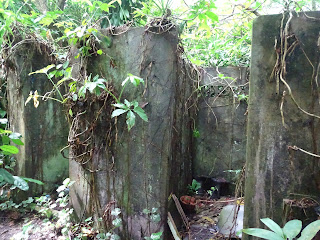

Dilapidated concrete washroom and laundry
In those times at the ruins of former Hainan village, the residents were built the washroom and laundry or storeroom made of concrete knowing that they (Chinese Immigrants) were from China in early years.

Upgraded Structure of wall and tiles in China taken in 2014
What surprises me is that the structure wall of washroom and laundry that looks familiar to the Hainan Village (Haikou) in China. It looks so identical in those times in China before they repainted and replaced new tiles a few years ago when my best friend and her family visited their relatives (her father's oldest sister & her families) in Haikou, Hainan Island in 2014.


Discarded items left by residents
Some discarded items at the washroom left by Hainan villagers.

A huge concrete house
I have seen some photos from my best friend that taken in Hainan village (China) that similar to her relatives's house that built huge house with high concrete wall used as the fence.


High concrete wall fence of old

Large concrete of dilapidated house
Abandoned decay of structure of large concrete homes of the Hainanese people is common in China whereas in Sg, they did the same when they arrived and settled down forming villages, make a living in the forests till they abandoned their homes and moved to housing estates when the government enquired the area.

Brick house/wall and concrete wall fence in China (2014)
The concrete wall fence that built along her relatives' house as their neighbour home is just next door in Hainan Village, China. So in Singapore, they built the same model structure houses made of concrete and red bricks but not volcanic rocks because Singapore has no volcano. I heard such eruptions close by:
Mount Sinabung, located 650km from Singapore, erupted in 2010 and 2013; Mount Bromo in 2010; and Mount Merapi, the closest to Singapore at 400km away, in 2004 and 2010. So.. Air quality in Singapore was not affected following these eruptions.

Mount Sinabung, located 650km from Singapore, erupted in 2010 and 2013; Mount Bromo in 2010; and Mount Merapi, the closest to Singapore at 400km away, in 2004 and 2010. So.. Air quality in Singapore was not affected following these eruptions.

A temple concrete wall and red brick fence?
What would made me think of this concrete wall and red brick of dilapidated structure of the former temple? I recall of that temple with the same pattern concrete wall and red brick of the demise temple in those times. Because my best friend who is Hainanese, a buddhist devotee and her relatives living in Hainan Village (China), They have built a temple near to their homes in China and so... it could have been one when they settled here and how their homes would be protected from harm and nature spirits of the trees for protection.

The well from rain water
Noticing the two wells that collected rainwater for Hainan village residents daily use in those times. In Hainan Village (China), these wells are similar as above. I remember the well of demolished Nee Soon Village that looked the same too. Just wondering if it's there or not. Picture as below


A Well at Nee Soon Village (1985)
Photo by nlb.gov,sg

Another lost village?
Maybe it's not....it could be some kind of another structure of the Grandstand or Looi's Motor in between old Upper Thomson road and Upper Thomson road. So it's up to you to decide.

Papaya
Papaya is one of the most popular fruits in Hainan. It is “cool”. Well, it does look like a Green Apple.....According to traditional Chinese medicine. So you can eat some papaya to cure your sore throat or constipation.
Bilimbi fruit (Taling Pling)
This Bilimbi fruit is related to Starfruit because of the shape when it cut, and can be used to cook with Fish Head Sour Curry or Soups.

Jackfruit (Nangka)
Jackfruit (Artocarpus heteropyllus) under family Moraceae or locally known as NANGKA in Malaysia is a popular fruit tree grown as tropical fruit trees. The nutrients found in jackfruit have powerful anti-cancer, anti-aging, anti-ulcerative, and anti-hypersensitivity properties that are valuable in the treatment of a number of diseases. I love this fruit when I was in my teen years and it feel sticky when your hands pick it to eat. 
Touch Ginger flower
While the other fruit but a flower and its buds that used to make a delicious Rojak dishes that I had seen with my old friend using a Rojak flower bud to make a Rojak dish for me in her stall years ago. It also spice up with Penang Asam Laksa I love most because of its smell the essence of the tropics with its sweet floral fragrance and a faint hint of ginger. And also Touch Ginger flower can be used for traditional medicine bathing which I collected it from the temple I often visit.

Purple Fungus
Purple and beige Bracket fungus growing out of tree stump!
A dead mouse?
After a long walk in the forest, I noticed a dead mouse above the tree branch so...I snapped it in blur image for you all to make out if it's really a MOUSE! If your eyes are sharp.

Electricity Pole fallen onto the branches of the tree trunk
Along the forest, a electricity pole had fallen among the tree trunk at the Jalan Belang close by of what the Hainan villagers had their home being installed in late 1960s till they moved out in 1975. To the farther down of the thick forests of what the road was named Jalan Pelita where the last GP at Starting Point was located.


Flower pot hanging on broken tree trunk
Seeing too many flower pots scattered over the places within the thick forests and old trees that remind us of the existence of a once Hainan village.
Let see the people of the forests of who is who.... is the Lord of the jungle, stomp trooper, jungle model...etc
The Joke of the day runs in the forested area..

Recon Patrol

Stomp Trooper of the jungle

The Lord of the Jungle

Tarzan of the Apes
The King of the Jungle...well not the Lion hor.....

Male Model of the Jungle

Forest Photographer
Well, at least I picked some of them as if I lost track of them...too many explorers on the run in the thick forests and I hardly captured them in single alone!


 To add on, one of the participants helped me to take a picture of the dilapidated large 'red brick' house using my Sony mobile phone and this is the only shot I have so far and at least I am glad that I was there as a memory of the place I went as times goes by.

Cheerleader of the group
Photo Credit: Nen Fatah
Jungle Cats Cheerleading group....
The Lost "Silly Fun" Garden
Photo Credit: Sarafian (Tuah)
At last, we ended the last trail of the unknown highest hill that we rumbled through the thick forest to walk up the concrete staircase which is possibility the resides of the Lost "Silly Fun" Garden to have a group photoshoot of the day.