Thursday, 2 June 2022

Khalsa Former Home

The construction of the dockyard HMNB Singapore (HM Naval Base) particularly its extension and refurishment in the early 1940s. Near the jetty, there used to be ROYAL TORPEDO DEPOT. Along the stretched road, there was ASIAN QUARTERS to housed coolies. The same site where the former Khalsa Crescent residents moved in 1950s to 1970s after it was newly built in 1950.
Newly built in 1950
Blk 1 foreground & Blk 2 far end on the left, on the right Blk 3 far end and Blk 4 foreground on the right.
The Present Day
In 1950s, the newly built Khalsa Crescent quarters of seven 2-storey blocks (former sites of coolies lines - ASIAN QUARTERS) to housed the families from Naval Base Police Force and Fire Brigade Quarters (later in year 1980). Fire Brigade Quarters (FBQ) caught fire and it razed to the ground in Feb 1980 and FBQ residents like Kamal & his family moved in at Khalsa Crescent in March 1980 till August 1980 at blk 3 Rm 17. 
Contruction site ongoing can be seen at the far end of the large outdoor shade. Rapid Transit System (RTS) will link to Thomson East Coast Line (TEL) from Woodlands North, will be completed by 4th quarter 2026. The site was once a "R.M.N. FOOTBALL & SPORTS GROUND (no longer exist) where Khaksa Crescent ex-residents' as their playing ground - soccer and others during their younger days.
Blk 5 known as "Admin Block" was housed the Sikh families in 1950s till 1960s, some families relocated to Rimau (View Road) when the Asian N.B. Police Barracks already started in late 1950s while some families stayed behind. Other families moved to Cochrane Crescent at the same year.
 Blk 5, 6 & 7 have common ground floor spaces where the festivals and  activities took place. The bachelors were housed at these blocks.
Bachelors' Block
Staircase leading up to the bachelors' restrooms. A long metal bell hanging by the hook at the wooden window.
Group photo of former Khalsa Crescent residents
A special invitation, a private session all former Khalsa Crescent residents and guests to be invited on 21st May 2022, and to reminiscing and sharing memories of their former homes for their 1st and their last farewell to their former home. Khalsa Crescent private event was organised by URA and NHB, in collaboration with Old Sembawang Naval Base (OSNB) group admins - Sofya & Kamal.
A Stretch of Seven 2-storey blocks
A home to the former Khalsa Crescent residents was once known as "TORPEDO DEPOT ASIAN ACCOMODATION" before it converted into Khalsa Crescent Drug Rehabilitation Centre (DRC) in late  1970s and it was changed to Khalsa Crescent Prison in June 2005 according to Prisons Act (managed by SPS) till it abandoned years later. The first Drug Rehabilitation Centre (DRC) in Singapore was the Opium Treatment Centre (OTC) at St. John’s Island. In 1977, Prisons Department developed five DRCs including Khalsa Crescent DRC.
In 1995, all drug addicts were sent to Sembawang DRC for medical checkup during their drug withdrawal and recuperation after their arrest. After recuperation, they were tranferred to other DRCs based on their records, the 3rd time inmates to Khalsa Crescent DRC.
Soon to be demoished to make way for new residental developments except Blk 2 to be conserved.
The children stood and posed at the street name - KHALSA CRESCENT wooden signage, behind them was Anthony shop made of wooden hut located the entrance.
The wooden signage was where the children stood located near the watchtower.
Photo Credit: Cheng YamSan
One former Khalsa Crescent Assam Pedas (a boy by nickname) and his grandmother at the rooftop of Blk 2 by climbing up through the 'open' window. Behind them was a badminton court.
This is Blk 2 where a boy and his grandma stood at the rooftop. Sadly, the badminton court was no longer there but a grassy field.
Group photo at Blk 2
Finally, we posed for the group photo, ex-residents have fond memories of their once meeting spot and their activities during their time at their former homes. They also shared fond memories and their stories here during their younger days.
There are 2 observation towers aka watchtowers in between entrance and exit, built for then DRC and Khalsa Crescent Prison.
Visit Entrance hut was built for the visitors, next to the watchtower near the entrance and Guard house (hidden from view).
The entrance to the Security Control Office (SCO). Visitors must produce their ID to the SCO before they are allowed to visit their loved ones. Also all Staff surrendered their weapons (The Arms) to the Security Control Office after office hours or off duty. 
I admitted...I accompanied my old friend whose brother was at KC DRC, walked in this building. He was a drug addict and had family issue. I declined further about his family.
Entry to Security Control Office
There are locker compartments on the right next to SCO.
The Locker compartment
Personal belongings should be kept in the lockers.
Security Control Office
The SCO was once Delta Isolation Hall, during that time DRC & Khalsa Crescent Prison occupied, the Hall became Security Control Office.
One former Khalsa Crescent resident, Keenman shared his memory about Bomb Shelter located behind blk 4 up the hill. We didn't go there cos' the gate was locked, the path we walked all installed caged fence.
Close-up of the bomb shelter
Former Khalsa Crescent residents stumbled the bomb shelter but didn't venture in bcos of bad stale air smell. There were broken helmats scattered near the entrance. 
I believe the bomb shelter had sealed up after DRC & Khalsa Crescent Prison occupied the premises.
My block and neighbourhood blocks also built above SCDF bomb shelter in 1990s, namely Civil Defence Public Shelter (HDB). It has been around more than 25 years. Currently the bomb shelters occupied by childcare educations and other organisations.
The Workshop 1 & 2
Workshop 1 has two sections which was a huge space whereas Workshop 2 has one section.
The DRC workshops provided trainings for potential inmates and offenders, to learn their job work skills during their journey of rehabilitation. By end of 2003, SCORE had 10 subcontract workshops, 4 each in Jalan Awan Prisons (JAP) and Sembawang DRC, one each Changi Prison and Khalsa Crescent DRC. They employed a total 900 inmates. My hubby's company also had 3 inmates to work at production lines, one of the inmates worked under my hubby's supervision. One inmate (attached a device on his leg hid under long pant) accompanied with SCORE staff to introduce to my hubby. Well, that was long time ago.

PRISON VISIT CUBICLES
The Visit Cubicles - DRC inmates can speak to their family members is through each cubicle using typical wall phone. There was also Syariah Court Tele-visit at the corner end of the Visit Cubicles. Over the years, the visit facilities had changed to a tele-visit through the screen via video call.
Finally, I found these cubicles accordingly to my old friend whose brother was there for drug offences and he was a glue-sniffer (considered drug addicton).
The 'large' Kitchen
Remember the word "MASAK" means "To Cook" in Malay in which the inmates, mostly male and chinese called this. The former inmates' pastimes in S'pore's Prisons and DRCs during 1970s and 1980s was to cook supper - was a CRIME. Old timers should have known about it.
The 'large' prison kitchen probably at blk 4, designed to provide food preparation for the inmates but before this, KC ex-residents used this kitchen to cook for their families, neighbours including the bachelors.
Delta Housing Unit
Due to increase numbers of inmates, the housing unit was added including the yard. The Yard located at the 2nd level of housing unit, gathered for the inmates to do their free time based on weekly basic. Yard time was the only time to breathe some fresh air and exercise. Inmates were not allowed to exercise in their cells.
There was also 'Outdoor' activities for the inmates.
Yard "Outdoor" activities
Inmates were ushered into the corridor outside their locked cells, where they waited for their turn outdoor at yard time. Facilities for basketball and sepak takraw (Kick volleyball) were made available. It built like a bird cage, with barbed wires fencing on all sides.
The 'Open-Air' men's loo (toilet)
There is a 'open-air' men's loo (toilet) at the corner near the gate inside the 'outdoor' yard. Well, there was two guys posed at this 'open-air' loo. So... who's the guys, from 'T.R.E.E' group? I have a photo of these 2 guys shot at the 'open air' loo.🤫
Life in Solitary Confinement
Inmate inside the singular cell can't see the sunrise or the moon at night.
Row of singular cells attached with dim-light bulb on top of the cell door.
A single cell for those who got serious crime that led into fight with other inmate or likewise.
Singular cell - a squat toilet, a shower and mounted wall propeller (installed with metal sheet with small hole) but no window.
There was no bed and the inmate had to sleep on the cement floor or the inmate used a towel/clothes that was given to him to cushion his back and backside so it's more comfortable unlike the other cell room had a long metal bed above the ground.
By living in singular (single) cells with little or no meaningful contact with other inmates. They were go 'crazy' if it carried on like this.
Ex-residents' rooms turned into prison cells
Walking in a passageway in a dim light was once Khalsa Crescent ex-residents' rooms turned into prison locked cells and installed grilled windows covered by a metal sheet with small holes, in each room as well as outside corridor including metal doors with a 'rectangle' hole (served cooked food) at the bottom.
The room that ex-residents stayed, had fond memories of what livelihood they had gone through all the years. To the KC ex-residents a 'Sweet Memories of home' and to the former inmates a 'Hell & Boring life'.
Every ex-resident's room or prison cell  has a story.
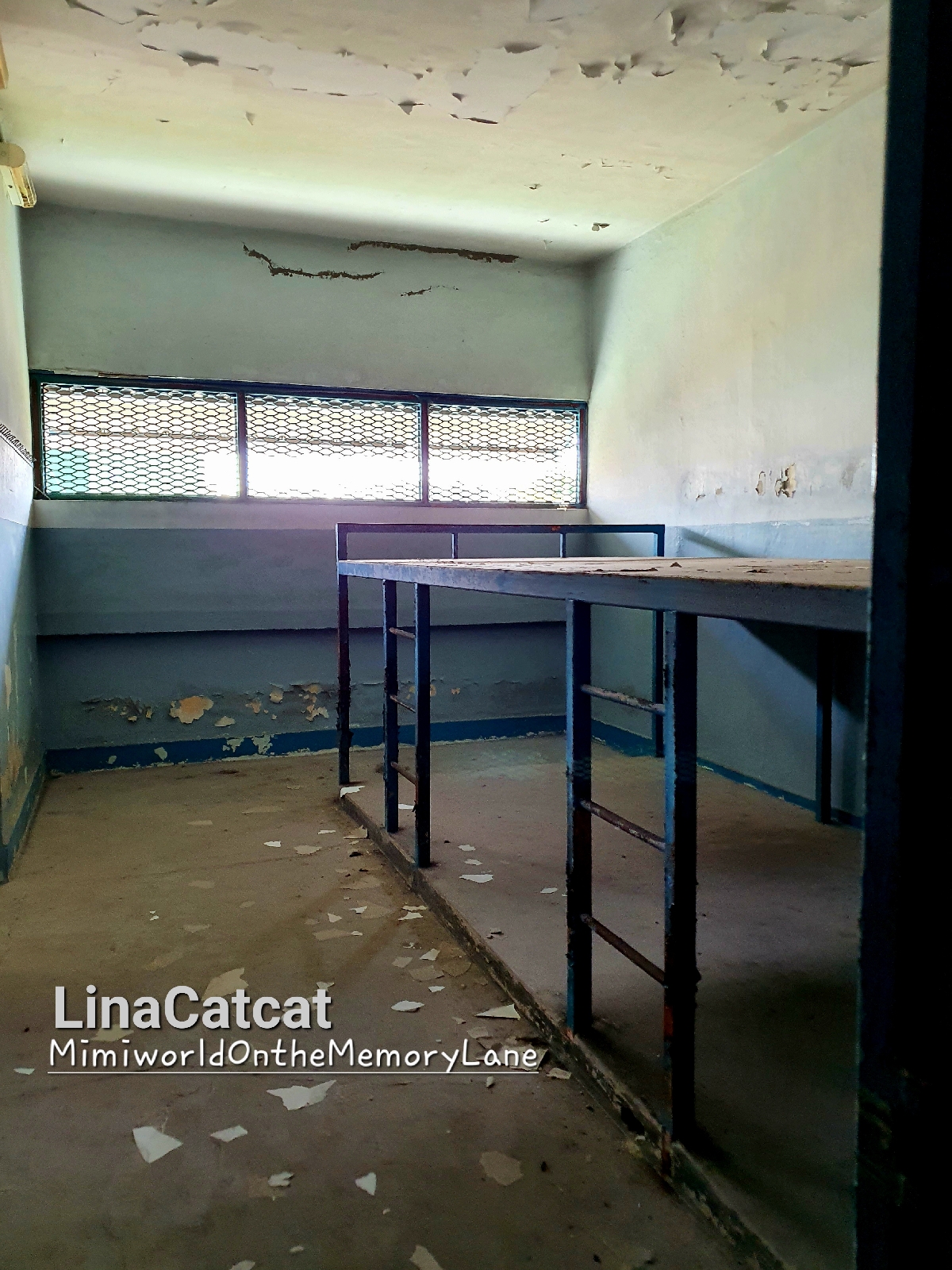
The cell room where the inmates slept on the top of the long solid metal bed. It can hold about 8-10 inmates in each cell room depending of the room size.
The 'blue' Spiral Staircase
The Group photo
Although we had a short time walking around, sweet memories and shared storied, separated into different groups. The tour took us a few hours to walk around the seven 2-storey blocks. But we had a great time, getting to know one another. 
It's indeed heartened to see former Khalsa Crescent residents' close bonding like families, even students and teachers whom they can't recognised each other when they were young at that time.
Another group photo
The T.R.E.E. group 😁

Tuesday, 31 August 2021

2021 Light-Up Mid-Autumn Festival SYS's Lawn

Note: "Those Moonlit Moments..." installed on 30th August 2021

Coming on the 15th day of the eighth lunar month this year, the Mid-Autumn Festival, also known as Mooncake Festival, is one of the most important festivals for Chinese communities around the world including Singapore.
Many locals celebrate mid-autumn festival every year.

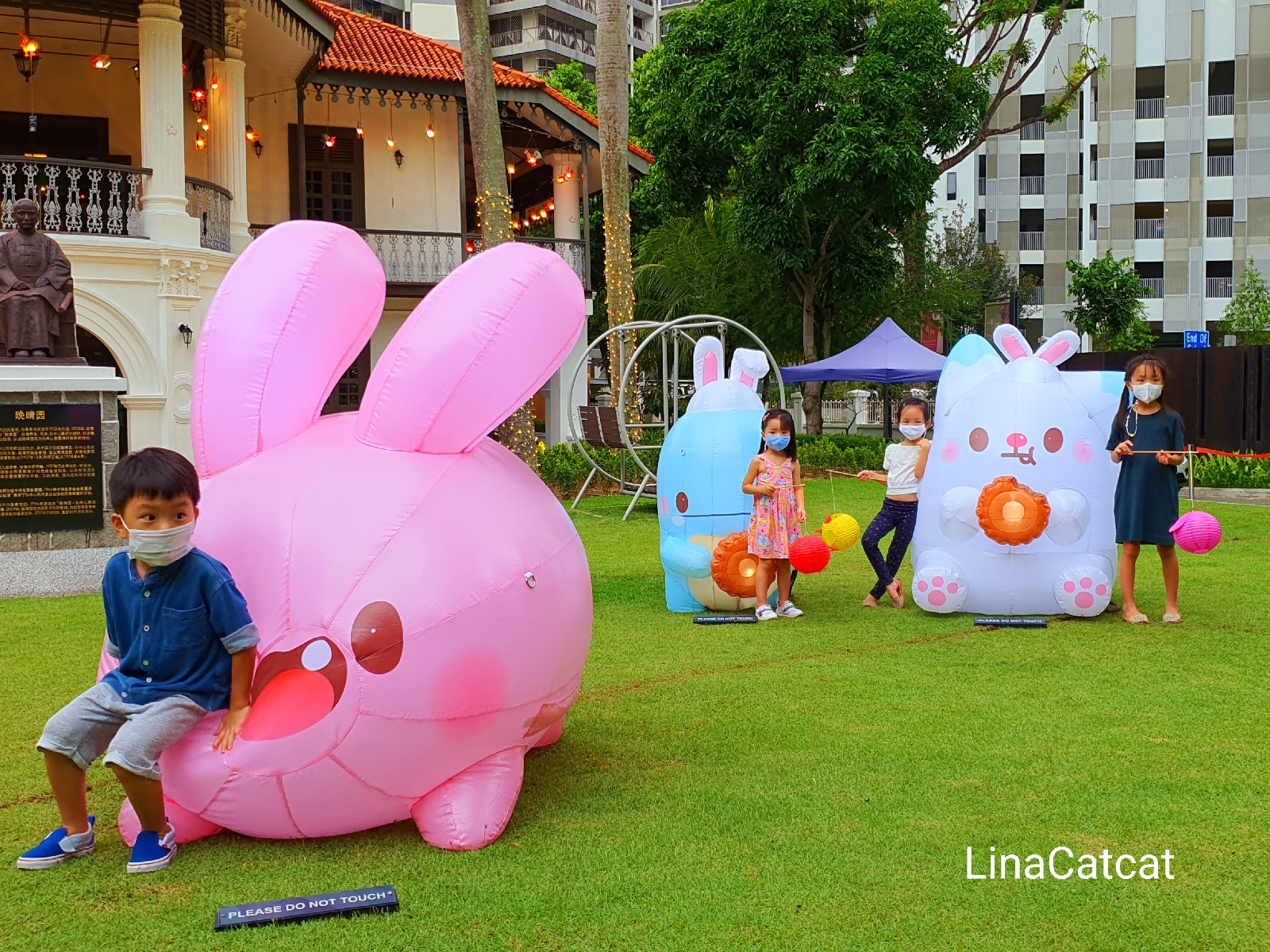
Lantern Installation: “Those Moonlit Moments..”

Those Moonlit Moments … is an outdoor installation comprising four large lanterns featuring the artist’s characters who are enjoying mooncakes and each other’s company under the gentle and watchful eye of Ngaew’s Moon Rabbit. The Moon Rabbit character was created specially for the Mid-Autumn Festival and is inspired by the Jade Rabbit from Chinese folklore which keeps the goddess Chang’e company on the moon.
The lantern (above pic) produced by Thailand artist Boonyavee Boonsakda (Ngaew Ngaew) in collaboration with the Sun Yat Sen Nanyang Memorial Hall.
The installation represents our collective wish to be able to get together and reunite with our loved ones, both locally and overseas, during these difficult times. It will be on display on the lawn of the Memorial Hall from 31 August to 26 September 2021, 10am to 9pm daily.
Date: 31 Aug – 26 Sept 2021
Time: 10.00am – 9.00pm (daily)
                   Lantern "Lion"
Digital Programmes
There is a digital programmes online via the memorial hall’s Facebook page (@sysnmh), this year’s Wan Qing Mid-Autumn Festival aims to bring heritage closer to home, through an exciting line-up of family-friendly digital initiatives such as learning how to guess lantern riddles, craft demonstrations and gamified content on the stories of Chang’e, Houyi and many more. 
                  Lantern Riddle
Deciphering Lantern Riddles! (for Children and Adult)
Date: 22nd Sept 2021 (for children)

Lantern Riddles often contain messages of wisdom and good fortune, and they are a fun way to practise language and problem-solving skills. Hints are provided to indictate whether the answer is a person, place, item or an idiom. Introduce your children to lantern riddles, and join them in the first episode with Riddle
 Association (Singapore) and Bong Qiu Qiu to find out the strategies and the thought process behind guessing lantern riddles.

There will be second episode for Adults with Riddle Association (Singapore) and Bong Qiu Qiu to find out the strategies and tips to guess the lantern riddles.
Date: 23rd Sept 2021 (for Adult)

What does Your Lantern Say About You?
Date: 14th Sept 2021
Lighting lanterns is a popular traditional activity associated with the Mid-Autumn Festival - they chase away the darkness, light the way home at night, and represent a desire for union and the aspiration for a better life. Most importantly, lighting add a touch of festivity and are a great fun for all ages. Find out the five types of lanterns most frequently found in Singapore, and which type of lantern may be more suitable with which type of personality! 
Could be your personality tells yo
u to pick one lantern of your choice? 😁

Help Hou Yi Shoot the Suns
Date: 17th Sept 2021
Did you know? Legend has it that there used to be tens scorching suns and it caused famines and sufferings to the people. An expert archer, Hou Yi shoot down nine of them and was rewarded with an immortal elixir. Help Hou Yi shoots the suns and learn more about the stories of Chang'e and Hou Yi!

Mid-Autumn Craft Tutorial: Create Your Own Unique Lantern
Date: 21st Sept 2021
Get your creative juices flowing and try your hand at making your own unique lantern! With the help of their DIY Mid-Autumn craft tutorial. Yoy could be able to explore using upcycled materials for a unique Mid-Autumn experience.

Learn More About Jade Rabbit
Date: 24th Sept 2021
Have yoy ever wondered why the rabbit is often featured in designs and decorations for the Mid-Autumn festival? Fibd out more from the video to learn the story of Jade Rabbit, its selflessness and its kindness!

Let's Celebrate Mid-Autumn Festival with Uncle Ting!
Date: 6th Sept 2021
Looking for activities to engage
 your child at home? Download our children's activity kit - Let's Celebrate with Uncle Ting: Mid-Autumn Festival to learn about the origins and traditions of this festival, the different types of mooncakes perferred by different dialect groups, and many more!

For more information and programmes click here 

Photos taken within Sun Yat Sen Memorial Hall during installation on 30th August 2021.
Thanks to Alvin Tan and his teams organising the media preview for installation of "Those Moonlit Moments..." We had an enjoyable time.
        Alvin Tan and his teams

Saturday, 13 July 2019

Kreta Ayer - New Heritage Gallery

Kreta Ayer Community Club
Along Kreta Ayer road was once a settlement area for early Chinese immigrants to Singapore thus became famous for cultural arts scene including Chinese Opera troupes and music scene that took place here. I have been watched Chinese Opera and puppet shows in my area since 1970s till 2000s and my mum was once an artist opera/performer (Sin Sai Hong troupe) in her younger days and she still love to watch it on TV when there is one. Those were the good old days.
The community where it stands along the Kreta Ayer road - Kreta Ayer Community Club is holding a official ceremony on the 14th July 2019, featuring a new Kreta Ayer Heritage Gallery in its premise to focus its rich cultural history. 
Kreta Ayer Heritage Gallery
The Kreta Ayer Heritage Gallery showcase which is slated to open to public on Sunday 14th July and will feature its five intangible cultural heritage elements: Chinese Opera, Nanyin instruments, Chinese puppetry, Chinese painting & calligraphy and Chinese tea ceremony.
A Cantonese Opera Male Kao (armor) costume
A Cantonese Opera Female Kao (armor) costume
This is a typical costume worn by an actor/actress playing a male/female general during battle scenes in a Chinese opera performance. The body of the costume is usually covered in scale-like motifs, which are modelled after ancient Chinese armor. Compared to the male general's costume, female kao costumes tend to incorporate a shoulder cape and more feminine touches such tassels. The Four-triangular flags attached to the back of the costume are a reference to pennants of command awarded to generals in the past. They also symbolise preparedness for war, and heightens the costume's dramatic effect. The flags can be removed after the battle scene is completed.
Chinese Opera Shoe (female)
Embroidered motifs worn by a "wu sheng" in a Chinese opera
Many of the cultural arts and traditional instruments were brought here by migrants from southern China which is linked to Kreta Ayer's rich culture history. There will be performing shows including puppet shows and lots of programmes.
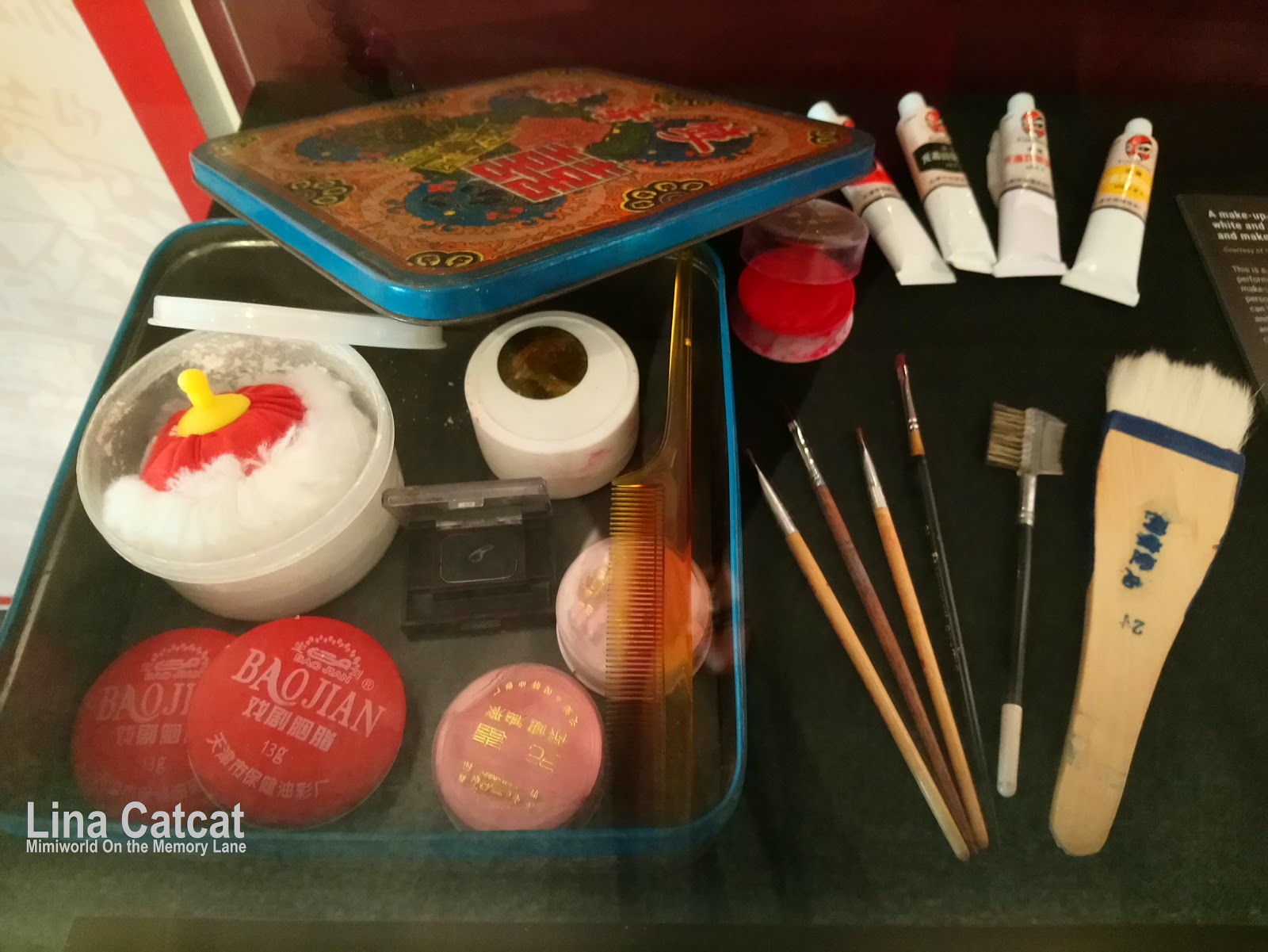
Typical make-up set
A make-up set containing black, white and rouge colours, a powder puff and a make-up brushes were used by opera performers. The colours and style in Chinese opera make-up are used to enhance the facial characteristics personality of a character. Different colours of make-up connote different meanings.
A wooden make-up box (loan by Part Woh Wui Koon)
This e-up box was typically used by the performers playing hua dan (young female) characters before WWII.
Puppet Theater
Puppet Doll
 Puppet accessories
Puppetry is an ancient form of artistic expression that is a variation on storytelling or human theatrical production. In puppetry, a drama unfolds that is entrirly or primarily acted out by specialized representational objects, which are manipulated by a puppeteer. The human animator may or may not be visible to the audience. Cultural variations of puppetry developed independently in many parts of the world, with distinctive types still carried on today.
Marionettes on strings or wire
A marionette is a puppet controlled from above using wires or strings depending on regional variations. A marionette's puppeteer is called a marionettist.


Marionette on strings

Marionettes were usually carved from pieces of wood and the assembled parts are hung on strings. Chinese marionette plays are mostly performed in the open air without a curtain to conceal the puppeteers.
Visitors may try their hand at the calligraphy, puppet shows, tea refreshment ceremony and more programmes that will held inside the gallery.
Nanyin music Instruments
Bamboo Flute (Dong Xiao) 
Some of the traditional instruments were donated by Siong Leng Musical Association for public viewing and education. These cultural practices still exists to this day. The gallery features showcase more than 170 photographs and artefacts contributions from cultural practitioners and former residents.
Chat Thye Poh's notebook
courtesy of Cindy Chat
This notebook used by Chat Thye Poh to record Cantonese opera lyrics. It was written on the first page are the actor's lines from a scene in a Cantonese opera entitled Li Qi Ran Jian ("Li Qi's cries from the Prison Cell" in Mandarin).
Membership Pass for Part Woh Wui Koon
(Cantonese Opera Artistes Guild)
courtesy of Cindy Chat
This Membership Pass was issed in 1956, belongs to Chat Thye Poh who joined Part Woh Wui Koon in 1934. The Guild that establilished for member of the Cantonese opera, was founded in 1857 and still operated in Keong Saik Road.
Vinyl records of Cantonese opera
Other contributors include: Ms Joanna Wong, a Cultural medallion winner and veteran Cantonese opera artist; Mr Yong Cheong Thye, an award-winning calligraphy artist; and Nanyin Musical group Siong Leng Musical Association.
Old Photographs of yesteryears
Notable items on display such as old photographs dating back to the 1970s that set the scene of the popularity and dynamism of Chinese Opera. In the late 1960s, Kreta Ayer's People Theatre used to host performances by international opera troupes in 1970s.
Gong Che Pu score book
There is one of a set of 3 Gong Che Pu score books containing around 300 original compositions, the music notes are created by the late Teng Mah Seng.
This is the first such gallery co-curated by National Heritage Board (NHB), community centre and key stakeholders to focus on intangible cultural heritage.
Admission to the Heritage Gallery is FREE. Operating hours from 12pm-8pm daily. It is located at the newly upgraded Kreta Ayer Community Club along Kreta Ayer road in Chinatown.
NHB Alvin Tan and friends(by invitation) at Kreta Ayer CC
Note: National Heritage Board (NHB) organises a special preview of the new Kreta Ayer Heritage Gallery on the 13th July and its official opening on Sunday (14th July) with tea ceremony and other programmes.
Exhibition wall panel
In addition, there is an exhibition wall panel just outside the Kreta Ayer People's Theatre. It was officially reopened in July 14th 2019 by Mr Chan Chun Sing, Minister for Trade and Industry, and Deputy Chairman of People's Assocication.
Below is a short video taken inside the Heritage Gallery. 

Saturday, 4 November 2017

Luxury Black and White Bungalows at Adam Park

Road to Adam Park Estate
Adam Park is one site where a series of war events unfolded. If you have a nice house that can't save everything then you've to think how to protect these structures and its heritage.
In the morning on 04th Nov, we took a cab instead of bus or station as it's just a short distance from my place about 10 mins. We arrived at 7 Adam Park before 9.45am and it's still early. As it could be the last series of 8th tours which was started on July 2017 conducted by Jerome Lim, supported by SLA.
View of 7 Adam Park
We roamed around the house and took some shots of the building and some quickie selfie shots with them.
7 Adam Park Bungalow
Upon reaching at 7 Adam Park Colonial house (NUSS Guild House), does it look familiar I recall that the house was once occupied by 7Adam - a chic and stylish restaurant-gallery in 2012. 
Selfie Before the Tour
The Adam Park Estate was an exclusive expat residential area with 19 huge colonial black-and-white houses, tucked away in the jungle and plantations of Singapore. Cocktails were sipped and long hours were whiled away at the country club playing golf in the years before the WWII. The estate was the site of an intense three days of fighting in the battle for Singapore. The men of the 1st Battalion Cambridgeshire Regiment held off a series of attacks by the troops of the Japanese 41st (Fukuyama) Regiment but the island collapsed to the Japanese.
The Allied soldiers were sent to Changi Prison and the estate was turned into a prisoner of war (POW) camp, with Japanese soldiers using the homes as a base.
The Colonial bungalow at 7 Adam Park that was used to house with Art Gallery, restaurant and workshops (for family and kids) in 2012 till early 2014. I remember that my friends once told me about Art Gallery and restaurant at Adam Park years ago. I did visited once in 2013 with two of my old friends for a meal at the park. 

No 13 Adam Park (2014)
In Jun 2014, I looked up 'The Adam Park Project (TAPP2)', is a ground breaking battlefield archaeology project managed by Jon Cooper, looking into the wartime heritage of the Adam Park housing estate in Singapore and joined them as volunteer digger to dig up the soil looking for relic items at No. 13 Adam Park. My interest is to look in its heritage of the building and its rich history of the battlefield as well as wars relic objects. 
Me Holding A Cap Badge@13 AdamPark
At the last moment, I unearthed a cap badge from Royal Corps of Signals at No 13 Adam Park in Jun 2014 as if God sent me down to look for it. That was 3 years ago!