Monday, 6 January 2014

The Fading of Tanglin Halt

Last July 2013, I visited to my auntie's shop upon hearing the Tanglin Halt estates had been identified for the Selective En-bloc Redevelopment Scheme (SERS) in 2008. Since then, over 60 units there have been sold. Some owners have time until August 2015 to sell existing flat.
Tanglin Halt estates
The area was once a hill peaks at that time, was a meandering road which stretched from Orchard Road to Queensway in the 1940s. Tanglin Halt Road, which was located near the south-western end of Tanglin Road, was named after the KTM trains which used to “halt” at the warehouse of the Archipelago Brewery Company (now known as IKEA) in Alexandra Road, where beer products were loaded onto the container trains in the past.
Blk 75 Tanglin Halt
The retro structure of seven blocks of flats (blk 74-80) was very alive in those days where the KTM railway track was behind the Tanglin Halt estates  Known to the residents as Tanglin Halt "chap lau chu" (Hokkien: 10-storey, 十楼), the neighbourhood has her own fair share of limelights in the history books.
Railway track behind Blk 79
Remembering the 1964 racial riots, personnel from the Malayan Riot Squad were stationed in four blocks at Tanglin Halt to pre-empt any outbreak of the riots in Queenstown area. The Anti-Riot vehicle commonly referred to as the Ang Chia (literally "red vehicle" in Hokkien) were parked along Tanglin Halt Road.
Bird view from newly 40-storey block
Taken from one of the five 40-storey of designated replacement blocks namely "Commonwealth 10" which evoked me to think of the old and formerly known of "Tanglin Halt ten-storey" - Chap Si Lau in Hokkien.
Closeup: Seven Blocks of Flats (74 to 80)
Remembering the sound of the boisterous honking as if it sounds like very rough and stormy, from the KTM trains was a common sight in Tanglin Halt where the residents lived, were irritated by the unpredictable bellows from the oncoming trains. The incoming train caused the residents numerous sleepless nights. Children would threw stones at the incoming train and some waved their hands gleefully.
Notice of Possession at Blk 77
Old lift of Blk 77
Typical old lifts at Tanglin Halt estates were common sight in old buildings and old industries. Children would love to play by pressing the buttons for the lift to go up and down till it breaks down and trapped inside and mischievous children would cry loudly till their parents rushed out from their units panicky.
 Laundry clothes dry out at staircase
Laundry clothes drying with nylon strings at the staircase were exposed in sight and the neighbours don't even bother even if their undergarments drying out of the space when neighbours walked down the staircase to see unhygienic clothes hanging can been seen everywhere of their neighbour's unit. It's very common among the and elderly residents and old folks living in this conditions for over the years.
Corridor of old
The original of brown wooden door without metal gate was not available at that time, they moved in after it was built. They had to install metal gate or roller metal gate by the time it was cheap back then. But old residents would prefer it in its original way to be kept over the decades as it was durable without any damaged to the door. After the years went by, the residents would painted the colour of the door, be it - red, blue or brown after the colour of the door was faded due to weather condition in Singapore especially raining season.
Lift Motor Room & Teleview Equipment
As for the younger generations might not see this before in old estates where there were lots of main equipment boxes and lift motor room mounted on the wall, located at the top floor or high floor end storey of which you might think, old residents would mention about main switch box at the top of their blocks. In our earlier generation, there was only one lift that shared with neighbours. If the lift breaks down, residents would call lift maintenance technical personnel to restore back immediately as there were many elderly residents who would not climb up the staircase if their unit was on the top floor. They have difficulty to walk up the staircase when the only one lift broke down unexpectedly as it was an old lift since they moved in early 1960s. Until in the later years, upgrading lift and the extension lift was installed just outside their block linked to the old staircase with new lift so that old residents would not have any difficulty to climbing up and down if one of the lifts breaks down.
Teleview equipment box and main switch box were for the whole block if there was a power trip and blackout occasionally and sometime all the time. I believe that mostly residents who used most of the sockets and adapters in their home and used often till the power trip again. Or because the power "station" circuit breakers also tripped. The whole block was in total darkness, even our phone lines were down due to the effected of Teleview switch box. Town Council was informed and sent technical experts to check the problems of frequently power trip all the time in old neighbourhoods area. It was indeed an experience for the young and old alike on how they lived with so many problems and got unpleasant stare from nasty neighbours.

 Old typical letterbox
Those days, the aluminium steel letterbox of old, you cannot find this letter box design in new HDB estate anymore. The 1st and 2nd of letterboxes were the same but only the new changes of the unit floor number without A-Z (then 543-J now 543-10) after 10 years later in 1970s.
Children's playground
The forlorn and quiet surrounding of the children's playground was the favourite of every Singaporean's childhood playground back in 1960s. Singapore pools and shops were seen in the background. Actually there are two Singapore pools outlets at Tanglin Halt of which one is at Blk 49 Tanglin Halt road at the corner end of the shop.behind at my auntie's shop opposite.
Main Water Valve
In early years,  local residents in old estates would come out to turn the tap manually when they need more water flows for washing their floor and washing clothes. My mum used to call me out loud that the running water is low or too slow that I went out to turn the tap outside my mum's unit manually. Those were the days, as a kid I used to play with the tap by turning on and off!
 Chin Hin Eating House
At the corner of Blk 75 Tanglin Halt where the old-fashioned coffee house - Chin Hin Eating House located and it operated for more than 5 decades that attracted office workers from industrial building and local residents who lived nearby. I had my lunch there many times when I visited my auntie's shop at Blk 46 and her home since early 1970s. 
 Crowded eating place
Storage area and fridge
Behind the eating house board marker, was the storage area and a fridge that unoccupied for years. I believe that it used to be a restaurant back then,
Wanton Noodle stall
Wanton Noodle Auntie
Tucked into my lunch meal that I ordered - S$2.50 "Wanton Noodle", a springy noodle was simply delicious and yet yummy. This auntie was abit eccentric though when I ordered from her! I don't even bother about her behaviour as it's just like my old neighbours who was fierce and strict in the past that was because old people lived in the old quaint kampung like my late grandma's kampong with their neighbours surrounding the forested or the jungle and that's their character turned more eccentric when they lived as a kid back then. People from all walks of life came here to feast their meals in reminiscing good old days, the clock was clicking away too fast as if it would not be the same again.
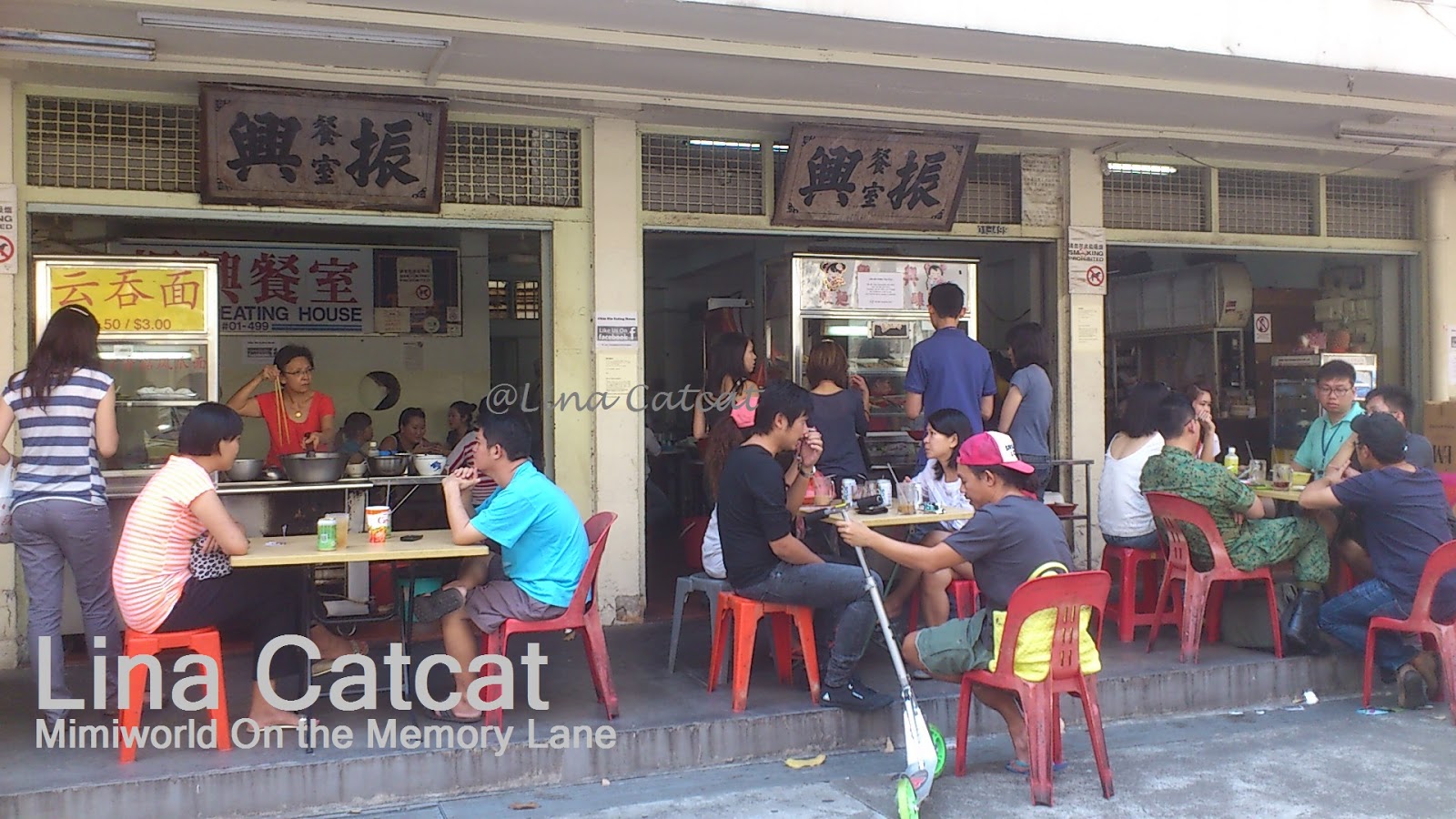
Good Atmosphere of Eating House
Such places like coffee houses in the old traditional way or old-fashioned seem too boring for the younger generations who might not like this kind of quaint eating places because of unhygienic. But this place has lots of history and nostalgia that long-time residents have great sentimental value on this place that they belonged.They lived and grew up for decades. Lots of local residents around the area were elderly and they often to patronise the coffee shop to drink coffee or tea in their spare time and chatting away with old neighbourhoods nearby. Now the Chin Hin Eating House will be closed its door for good on 24th February 2014 and thus brought back sweet memories of their 40 years here and not forgotten as the time goes by.
My former kindergarten
My first kindergarten was at Queenstown Lutheran in early 1960s where my mum's old block located in Commononwealth nearby before switched to Tanglin Halt Kindergarten when I was 5 year old in 1960s, that when I was accompanied by one of my auntie who lives in Tanglin Halt as my mum was busy back then. I remember fondly on how I was started to cry when I enrolled to kindergarten in the first place, as told by my mum. How time flies! It's been more than 5 decades.
O recall that there was once a Pasar Malam along the Tanglin Halt estates on Fridays and Saturdays nights at that time where there were lots cheap items to buy and the foods tasted to try the good old days.
The fading of Tanglin Halt estates will be demolished in 2015. How time flies. Times flies when you were having fun and sweet memories of the place or it's been 5 decades since I stepped into this old neighbourhood in my kindergarten days.

Monday, 30 December 2013

Tai-O the Oriental Wonder of Fishing Village

Tai-O the Oriental Wonder of Fishing Village
The Oriental Wonder of Fishing Village, the oldest fishing villages located on Lantau Island, at the northwestern shore of Hong Kong, the stilt houses (Pung Uks literally shack houses) build on water in Tai-O that has retained its charm with its old wooden houses with "half" part of aluminium-steel like tin roof to the front like "tin-can container" along the sand-based footpaths. Pang uk developed from the boat houses of Tanka (蜑家) or fishing people, after they moved to reside on land. There are rows of stalls selling dried fishes, salt fishes, dried shrimps, salt eggs, shrimp paste and others as well as Chinese herbs too.
Nature and hiking trails have been established as well as the plans to restore some old salt disused salt pans to show and educate the tourists and visitors on how Tai-O was famous in its rich history for salt production.
Window Aircons mounted on wall of tin houses
They built Tin-Can Cabin out of Shipping Containers.I think. 
Back of the Tin Houses
Part of the tin houses (tin-can container) that build on water or along footpath and small window air cons on wall at the back of the tin houses. Inside tin-can container houses are warm had little cool air flow into the houses during summer time.
Dome-shaped container house at the back
This is interesting to see different sizes and shapes of the houses that made out of shipping or tin-can containers to build it. As if the "back" of dome-shaped container is connected to the front tin-can house (see above) that facing the sea.
Rusty Tin-can container houses
After a long period of time, the outside wall of the tin-can container (tank) houses or aluminium steel houses would become rusty in time to come. And the residents would rebuild it or just leave it whatever it is.
Narrow corridor of shipping container houses
It is indeed difficult to access which is too narrow along the corridor of one of the shipping container houses that connected to each other while others side by side closely to one another. The "space" floor outside container-shaped house (pic - top second) is characterised by the black & white sheet flooring, rarely seen in Tai-O.
Tai-O has an interesting story to tell and its rich in history among fisher folks who live their life in their fishing village on the water for generations. Fisher folks started to reside since the Ming dynasty and has the reasons to build up their traditional Chinese Stilt houses can be seen in the geographical and ecological location of Tai-O.

In year 2000, a large fire broke out destroying many residents' houses. The village is now mostly squatters huts and dilapidated stilt or rackshacle houses.
Tai Chung Footbridge and I
Rope-Drawn Ferry Bridge or Tai Chung Footbridge built and completed in 1996 where many local residents and fisher folks need not to use their boats crossing the river and it's very convenient for them.
Boat ride to see dolphins
For a small fee of HK$10 and KH$20, some residents will take tourists out on their boats along the river and for short jaunts into the sea. Many tourists as well as local residents mainly from Hong Kong, Macau, Taiwan, Singapore and other countries come to Tai-O specifically to take these trips to see Chinese white dolphins. It is also a good place to see the sunset.
A historical Welcome Arch of Tai-O
We went to Tai-O on the 30th Dec after touring other places that we visited on our own. Since we have heard about the oldest fishing village in Hong Kong years ago but we didn't make a trip there till today due to our hectic schedules. It was a pleasant trip and saw lots of colonial buildings and former police station (now a nine-room hotel).
Another Welcome of Tai-O
Recent welcome sign of Tai-O is designed by Mr Yeung Tak Ming on Lantau Island and is managed by Islands District Council.
Tree house
Ever wonder what a tree house look like that built under wooden tree truck and steel pole to support the house roof with full of tree branches on top. The tree trunk is outside the house that covered the makeshift aluminium shelter using the long metal steel on each side.
Tai-O Bakery stall
This Tai-O Bakery stall is located at 66 Kat Hing Street, operated more than 30 years since 1980s, Tai-O Bakery are producing the authentic Chinese traditions, is one of the making cookie, the most traditional and original tastes to the people from all over the world. They use quality raw materials. All the products are hand-made, freshly made,including the famous "Tai-O Donut", "Chocolate with Peanut" ,"Chinese Walnut Cookie", "Tai-O Sesame Cookie", "Egg Tart", "Lady's Cake" and lots of traditional Hongkonger-style bread.  Too bad, the stall closes today.
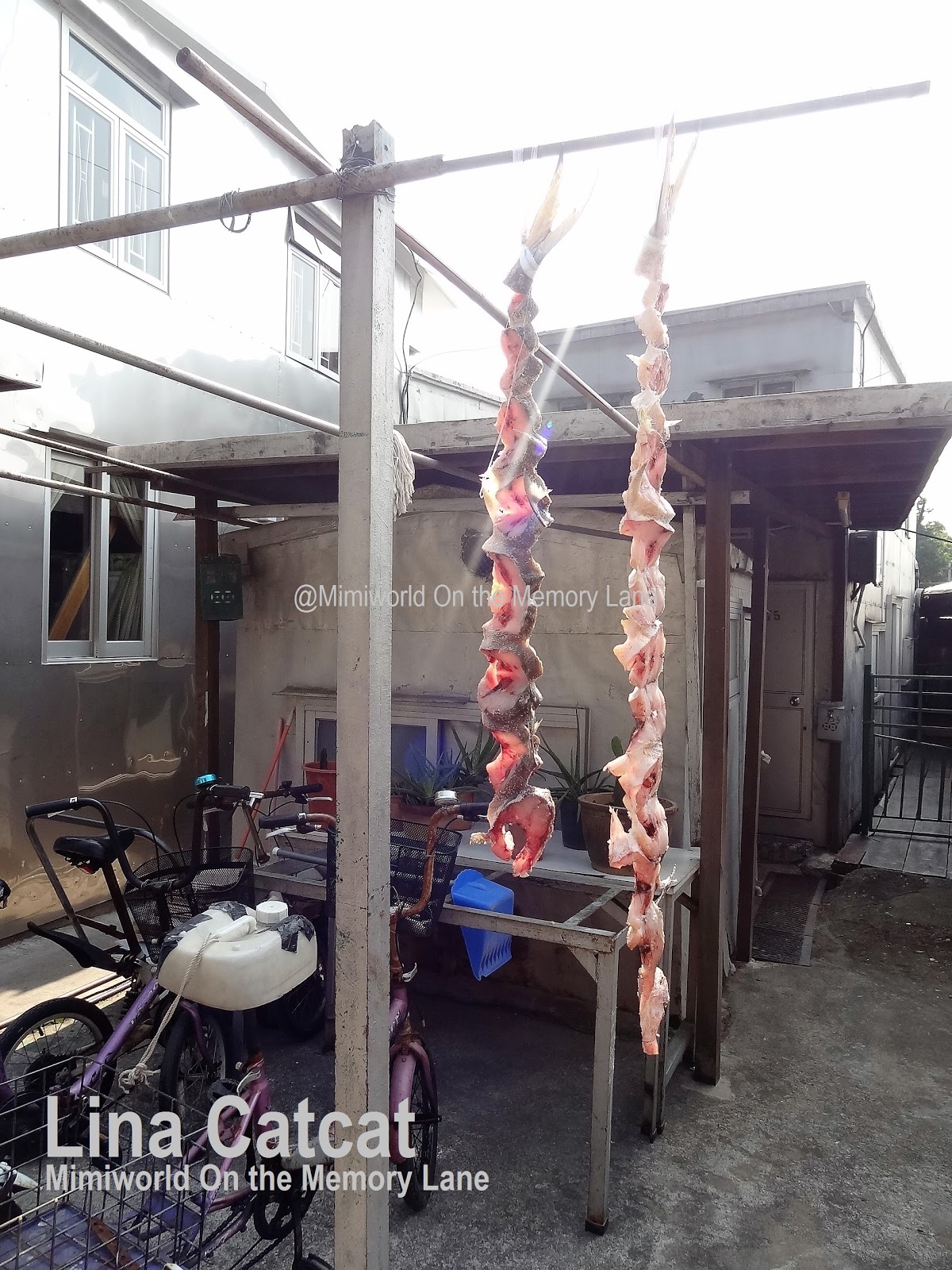
 Dried Salt Fish (Really to sell)
Before that, but how to make dried fish. Well, below is the answer.
Salt Fish to dry
I was told that the Fisher Folk, is to remove the internal organs then wash the fish body and put salt all over the body. Then later, place the fish layer-by-layer inside a big wooden box filled with salt. Remove the scales, wash the fish, wrap the head in paper and then dry the fish in the sun for five to six days.
Fish dry in the sun in a cool air
Mostly local residents from Hong Kong and Taiwan came to Tai-O to buy dried fish and others from the stalls or the Tai-O market when they visit again.
Salt fish hangs to dry
Some local Tai-O residents hang their fish to the pole to dry for days with using a thread tight up just outside their houses clearly seen to the visitors. If you can smell the fish everywhere and you could love to buy their salt fish at the market or the stalls.
Dried Duck salt egg yolks
While Tai O's fishing industry has shrunk dramatically in recent years, many of the village's traditional goods are still sold by locals to visitors. The area's once a prolific salt marshes still yield the salt used to dry egg yolks and fish. Through an open door the click-clacking sound of mahjong tiles can be heard; not far away two platters of salted egg yolks sit drying in the afternoon sun.
One of the fish stalls
Some of the fish stalls are friendly, photo is allowed to snap of the stall and dried foods and salt fish are acceptable to tourists who came to see or even buy their dried foods as well as shrimp paste..


 Front view: Tai-O Market
Back view - Tai-O Market
At most, visitors and tourists who flock to the market located in Tai-O that sell a plethora of unique dried fish.dried seafood, fish. salt fish, dried cuttlefish and others can be found at Tai-O market along the street of Tai-O.
Old woman using an old weighing scale
An old woman aka fish seller is using old-fashioned weighing scales to weigh the dried fish – just holding the scale with one hand and balancing it out with weights, to establish the price of the dried fish when the customer asks for 500gm of dried fish.
Tai-O Market Street sitting out area
This shelter is located at Tai-O Market Street just outside the market for the visitors to rest after they walked for about two hours or so.
Dessert Pancake stall (waffle)
Dessert was an easy choice, a Charcoal Grill Eggy Pancake for 20 HKD or more. Basically, a waffle with no syrup. Most residents live on stall and their houses are on the upper level as seen above.

Making Egglets (egg waffles) using charcoal

I had seen and smelled these at many of the Asian markets in other countries including Singapore, but none were using concrete block (grill) with charcoal as their heating source. It seems to make a very crispy difference for local and visitors alike.
Milk Tea stall
This stall has an unique stretch & painted artwork of Tai-O postcards would fetch HKD$7 per piece and also sells iced milk tea, tea eggs and others.
 Seashells and bracelets
Most important is - Do not touch the items if you are not buying when it is written on the carbon box (seen above picture) that placed on seashells and other hangs on seashells bracelets. I believe that some tourists or visitors are itchy hands to touch when not careful it might break the shells or drops it onto the ground.
Spotted cute wooden giraffe
Walking past a cute wooden giraffe (toy head) stands along Tai-O Wing On street, inscribed on a piece of white paper indicated to the visitors to take a shot of it once they spotted.
Fur Cat stood on vase
As we walked along the stalls and stilt houses on other side, I saw a beautiful Tai-O stray cat with a pink collar and a pink bell at the flower vase, stood beautifully posed on the vase and I took a picture of it.
Cat with a pink bell
She looks so sweet with a pose in its silky unique fur patter and colour create something unexpectedly beautiful and unique. Someone must have taken good care of the cat that lived nearby.
Two cats on top of shelter
One of the two cats, on the right, sits, a stripes orange tabby.cat does lookalike of my beloved cat of 15 years. I stared straight a orange tabby cat with sad eyes that reminds of my cat named - Mimi.
Cats@Tai-O shop
I remember that there's a shop that housed stray cats, cat foods and cat's play pan. Tai-O must be a paradise for stray cats, with lots of seafood and fish at every corner of the stalls. No wonder, the cats love to hang around in this place.
Tai-O resident and his dog
We hardly see the dogs around Tai-O fishing villages and managed to spot one Tai-O resident and his dog's collar tight up using a pole to the back of bicycle's box,  running for his work place.
Dog's Poop
There's a dog poop (WC) station for Tai-O dogs on the street of Tai-O for local resident's dog doing his business.
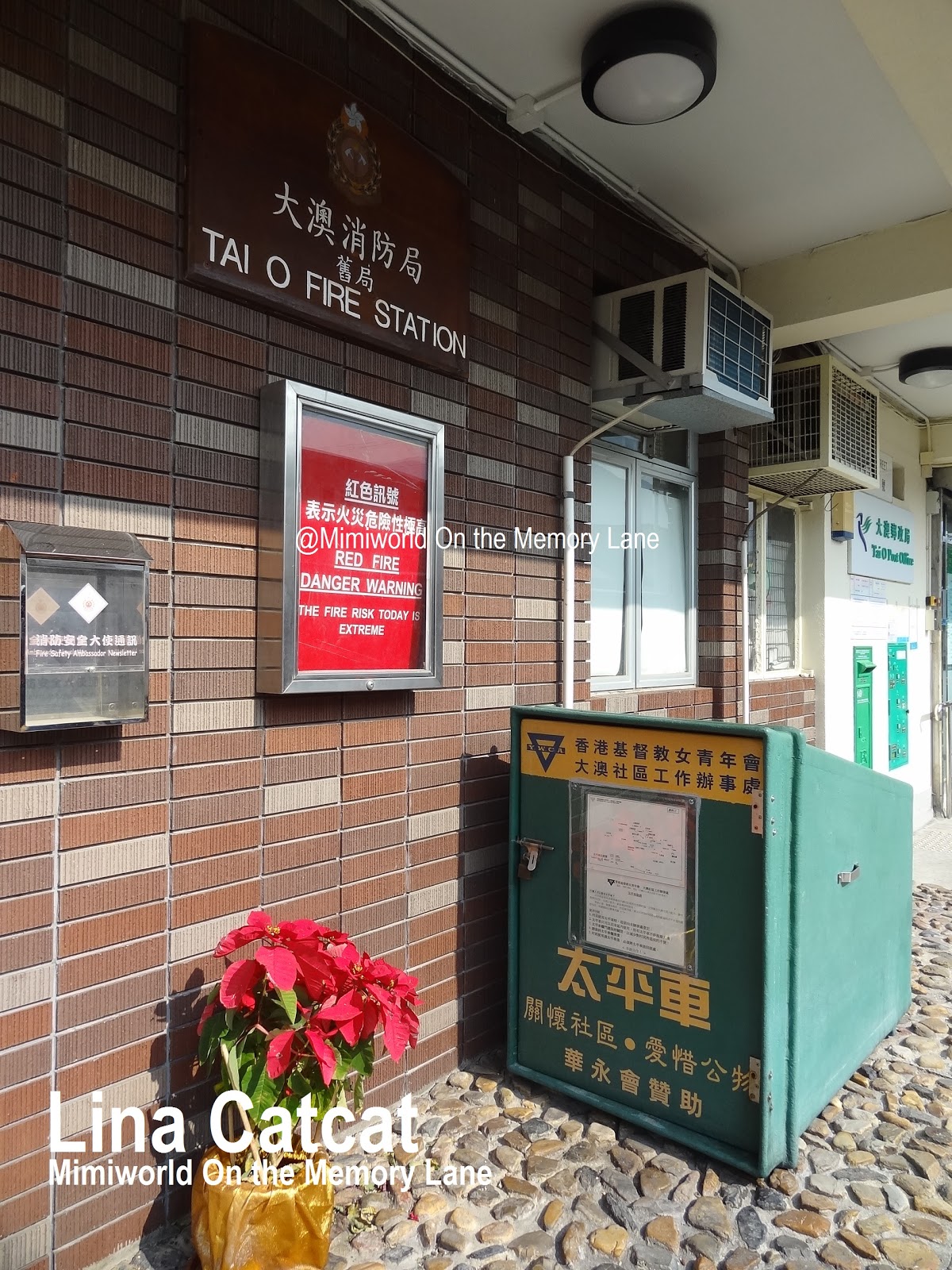
Tai-O Fire Station and Tai-O Post Office
Closeup: Tai-O Fire Station
The common sight along Tai-O are the buildings that housed two adjacent to each other - Tai-O Fire Station and Tai-O Post Office.
Tai-O Substation
Tai-O Substation is to provide electricity to all local residents in Tai-O and  2nd storey of Tai-O substation that provides accommodation for those who work in the substation. But why do they need a regular maintenance at the Substation?
Sun-Ki Bridge
At that time, the Tai-O community and local fisher folks used punt-across the river before the Sun-Ki Bridge was built in 1979, was financed by the local residents and completed within a month. Thus travelling between the tiny island became quite inconvenient for old fisher folks and Tai-O community. And the Sun-Ki Bridge was replaced similar to the Tai Chung bridge (newer iron bridge), the old hand-pull ferries in the late 1990s
.Ramshackle houses on semi-polluted water
The ramshackle houses perched perilously over semi-polluted water, threatening to collapse and be swept away by the next typhoon. It’s said that every year there is a special evacuation for these local fisher folks and residents, during heavy storms, and many lose their homes and they rebuild their houses again. They should have build "Storm-resilient shelter" and "Typhoon resistant shelter" to accommodate all residents close to their stilt houses and tin-container houses. These houses found among the dense forest land and at the bottom of jagged volcanic mountains.
The incredible number of temples in this small fishing village is the best evidence to prove Tai O residents' faith in this old saying, "Worship was the blessing of God more than God's own". Tai O residents display devout reverence to hope for peace, health, fortune and happiness, making Tai O ever-shining with abundance of blessings.
Within Tai-O fishing villages and its temples namely 'Hung Shing temple (Shek Tai Po street), Kwan Tai temple (near Tai-O market), Tin Hau temple and Yeung Hau temple locates along Sun-Ki Bridge.
The narrow lane of Tai-O
After we passed by the Sun-Ki bridge, we saw a local resident rode on his bicycle on a narrow lane of Tai-O and on the right side, is the "red" wooden staircase leading up to the back of the house's door.
We managed to spot three out of four temples except Yeung Hau temple as we had not much time to wander further to the Sun-Ki Bridge where the Yeung Hau temple is. We will be back again if time permits. A little known about heritage temple - Yeung Hau temple is a place that housed the urns of the deceased, placed in a cremation wall inside the temple. Yeung Hau temple is the oldest temple, built in 1699, a dedication to the deity of Hau Wong, the historical figure symbolising loyalty and bravery. Hau Wong, originally named Yeung Leung-Jit, was a faithful and courageous general in the Southern Song Dynasty. He was honoured for his loyalty in protecting the Emperor Song as he took refuge on Lantau Island, and was revered as Hau Wong after his death.
Earth God
There are also "Earth Gods" along the street of Tai-O fishing village and some are located beside fisher folks' houses
Kwan Tai Temple
A heritage temple -  Kwan Tai Temple has the longest history in Tai O and built in 1741, located at Kat Hing Back Street. This temple is dedicated to the Chinese god of war, a Taoist symbol of force, loyalty and righteousness. Kwan Tai, also being called Kwan Wun Cheung or Kwan Yu, was a legend of military competence and virtue in the Three Kingdoms period. As recorded in historical accounts, Kwan Tai was not just a valiant red-faced general, but also an unconquerable hero in the eyes of posterity. In the heart of the people, Kwan Tai has become an omnipotent figure with multiple roles: god of war, wealth and various industries, as well as an exorcist and guardian figure.
Tin Hau Temple
Tin Hau temple is connected to the left of Kwan Tai temple built in 1772, is not simply the goddess of the sea, but also the guardian of the Tai O fishermen who drift and wander on its waters throughout the year. In the face of unpredictable weather and unreliable communications equipment several centuries ago, fishermen or fisher folks could only put their faith in the sailing experience of the older generations. The local residents of Tai O have always felt vulnerable when rainstorms sweep the village, and so Tin Hau became a spiritual pillar to support and bless Tai O residents with standing the ever-changing weather.
More than a century ago, legend has it that Tin Hau who stood on the shore, guiding fishing boats home, unflustered by tempest and storms. Tin Hau was then regarded as the sea goddess (similar to "Mazu" (Goddess of the Sea) with the strongest magical power over the water.

The statues of the four temples will be used as a traditional Tai-O Dragon Boat Water Parade which takes place on the fifth day of the fifth lunar month. It is an over a century (100 year) traditional ritual and was listed as a item of the Intangible Cultural Heritage in 2011 as China's third national list.
Tai-O Association
Before the festival, the fishermen row their dragon boats to visit the four temple and carry the statue of each temple to their Associations' halls for worship. Then on the day of festival, the deity statues are put on sacred sampans and towed by the dragon boats in a parade through the waters of Tai-O to pacify the wandering water ghosts. Many Tai-O residents of the stilt houses that are sprinkled along the watercourses burn paper offerings as the dragon boats pass by. The deity statues are then returned to their respective temples after the ritual. It's their traditional way to bless the fishing villages for safe, peaceful.and prosperous.
Tai-O Primary School
Furthermore, there used to be lots of schools in Tai-O. Now, most of the schools in Tai O have closed down. "There used to be more schools here," An old resident says. Now, only the Church of Christ In China Tai O Primary School and Buddhist Fat Ho Memorial College remain. The teachers in Tai O's kindergarten and primary schools continue to offer free tutoring lessons outside of class so that their students do not miss out on their education. Some students study outside Tai-O and the kids have to get up at 6 am and walk to the bus terminus to catch the public bus to Tung Chung as there's no school buses are available.

There is a printed on a poster in the Tai-O Rural Committee Historic and Cultural Showroom, there will always be those who want to stay to "maintain their culture and their sense of community by helping to preserve the material heritage of Tai-O".

We will revisit Tai-O again to complete the other half of our own trail when the time comes!

To go Tai-O:
From Hong Kong or Kowloon, take the MTR Tung Chung line to the final stop.
If you don’t mind an extremely curated tourist experience, take the Ngong Ping 360 gondola to Po Lin Monastery and then go by bus no. 21  to Tai O.
From the Tung Chung MTR station exit B, hop on a bus no. 11 (takes about 50 mins) to reach Tai O.
If you’re adventurous and the winds clear out the air pollution, try hiking the Lantau Trail to Po Lin Monastery, staying the night at the monastery, and then onto Tai O.
To return to Tung Chung MTR station:
Return by bus no. 11 to Tung Chung MTR station at Bus terminal station at Tai-O or boat ferry to Mui Wo.